
Stock Investing for Beginners: A Complete Guide to Understanding the Stock Market
Discover how stocks work, why companies issue shares, how investors build wealth through the stock market, and the strategies that can help beginners invest with greater confidence. Whether you're investing for retirement or long-term financial goals, this guide explains the essentials in simple language.

Disclosure: Ads are displayed on this site. The information provided is for educational purposes only and should not be considered financial or investment advice.
Key Takeaways
- Understand what stocks are and how owning shares represents ownership in a company.
- Learn how the stock market connects investors with businesses seeking capital.
- Explore the different types of stocks, including growth, value, dividend, and blue-chip stocks.
- Discover the benefits and risks of investing in stocks.
- Learn practical tips for beginners who want to start investing responsibly.
- Explore related guides on ETFs, Mutual Funds, Bonds, and Index Funds.
Stocks are one of the most widely recognized investment opportunities in the world. Every day, millions of people buy and sell shares of companies through stock exchanges with the goal of growing their wealth over time. Whether you're investing for retirement, saving for your children's education, or building long-term financial security, understanding how stocks work is an important first step.
Owning stocks allows investors to participate in the success of businesses. When companies grow their revenue, increase profits, or expand into new markets, shareholders may benefit through rising share prices or dividend payments. While stock prices naturally fluctuate, history has shown that diversified stock investments have been an important component of long-term wealth creation for many investors.
What Are Stocks?
A stock, also called a share or equity, represents partial ownership in a company. When you purchase shares, you own a small percentage of that business. As an owner, you may benefit if the company grows in value or distributes a portion of its profits through dividends.
For example, if a company has one million shares outstanding and you own one thousand shares, you own a small percentage of that company. Although individual investors typically own only a fraction of large companies, every shareholder has a financial interest in the company's performance.
Companies issue stocks to raise money for expansion, research, hiring employees, developing products, or acquiring other businesses. Investors provide capital in exchange for ownership, creating a relationship that benefits both the company and its shareholders when the business performs well.
Why Do People Invest in Stocks?
People invest in stocks for many different reasons. Some hope to achieve long-term capital growth, while others seek regular dividend income or portfolio diversification. Investing also allows individuals to put their money to work instead of relying solely on savings accounts, which may offer lower long-term growth potential.
Successful investing is usually based on patience rather than trying to predict short-term market movements. Many experienced investors focus on owning quality companies for years or even decades, allowing compound growth to work over time.
Common Reasons People Invest
- Build long-term wealth.
- Prepare for retirement.
- Generate dividend income.
- Help protect purchasing power against inflation.
- Participate in the growth of successful companies.
- Diversify their overall investment portfolio.

How the Stock Market Works
The stock market is a marketplace where investors buy and sell shares of publicly traded companies. Instead of meeting buyers and sellers in person, transactions take place electronically through stock exchanges. When an investor places a buy or sell order through a brokerage account, the order is matched with another investor who is willing to trade at an agreed price.
Stock prices change throughout the trading day based on supply and demand. If more people want to buy a company's shares than sell them, the price generally rises. If more investors are selling than buying, the price usually falls. These price movements reflect investors' expectations about a company's future performance, economic conditions, interest rates, and other market factors.
Today's investors can buy and sell stocks using online brokerage platforms, making investing more accessible than ever before. Many brokers also provide educational tools, research reports, and portfolio tracking features to help investors make informed decisions.

Stock Exchanges
A stock exchange is an organized marketplace where publicly traded companies list their shares and investors buy and sell them. Exchanges help ensure that trading is transparent, regulated, and efficient.
Some of the world's largest stock exchanges include the New York Stock Exchange (NYSE), Nasdaq, the London Stock Exchange (LSE), the Tokyo Stock Exchange (TSE), and many others around the world. Companies must meet certain listing requirements before their shares can be traded on these exchanges.
Although investors may purchase shares of companies listed in different countries, they should understand the regulations, currency risks, and market conditions associated with international investing.
Why Stock Exchanges Matter
- Provide a secure marketplace for buying and selling stocks.
- Help companies raise capital from investors.
- Improve transparency through financial reporting requirements.
- Offer liquidity so investors can buy or sell shares more easily.
- Support price discovery through open market trading.
Bull Markets vs. Bear Markets
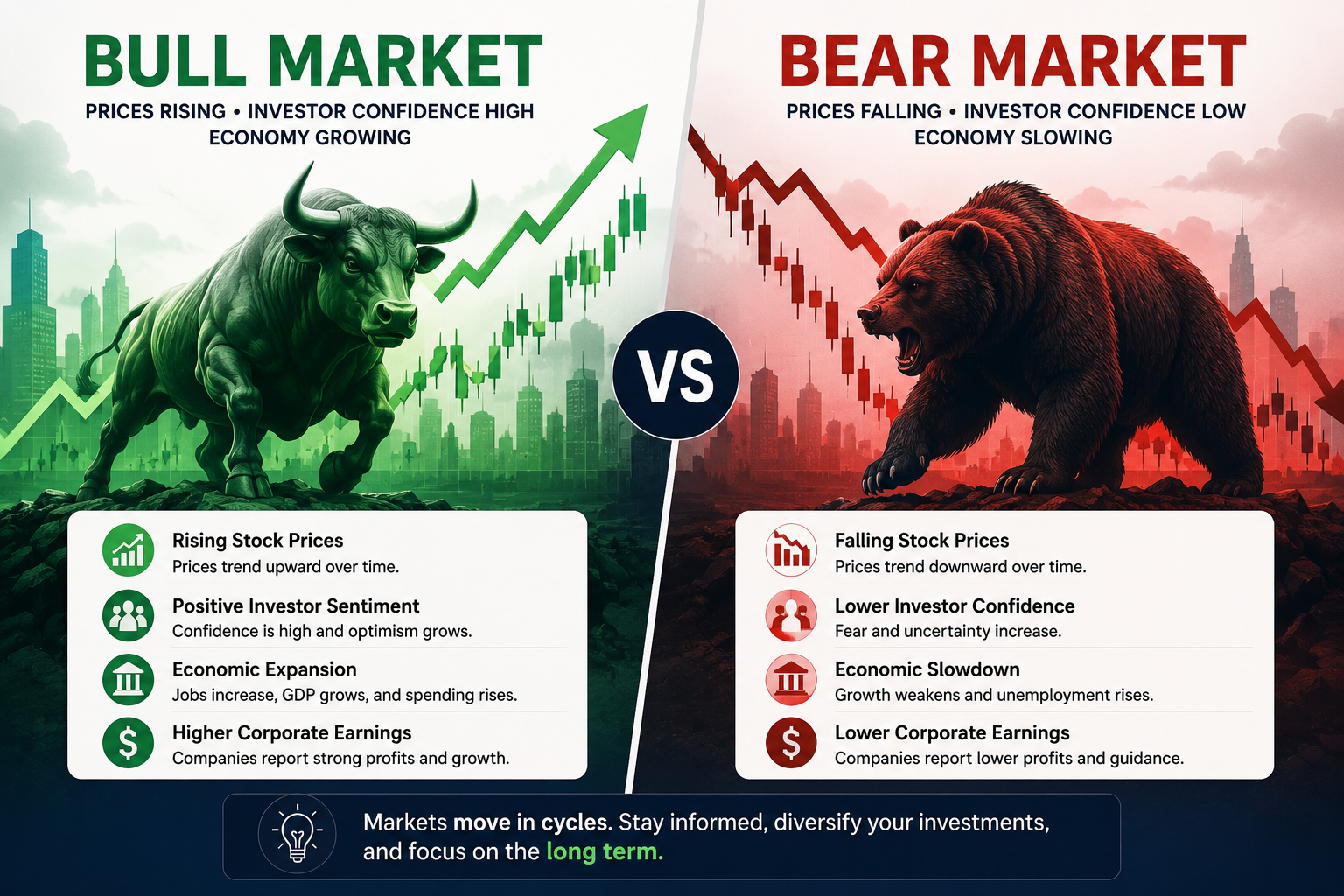
Financial markets naturally move through periods of growth and decline. Investors often describe these periods as bull markets and bear markets.
Bull Market
A bull market is a period during which stock prices generally rise over an extended period. Bull markets are often supported by strong economic growth, improving corporate profits, and positive investor confidence.
- Rising stock prices
- Positive investor sentiment
- Economic expansion
- Higher corporate earnings
Bear Market
A bear market occurs when stock prices decline significantly over a sustained period. Bear markets are often associated with economic slowdowns, uncertainty, or financial crises. While these periods can be challenging, many long-term investors continue investing consistently rather than trying to predict market bottoms.
- Falling stock prices
- Higher market volatility
- Lower investor confidence
- Economic uncertainty
Understanding Stock Market Indices
A stock market index measures the performance of a group of stocks. Rather than tracking a single company, an index provides a snapshot of how a section of the market is performing.
For example, some indices follow the largest companies in a country, while others track technology companies or companies across different industries. Investors often use market indices as benchmarks to compare the performance of their own investment portfolios.
Why Market Indices Are Important
- Measure overall market performance.
- Help investors compare portfolio returns.
- Serve as benchmarks for many investment funds.
- Provide insight into economic and business trends.
- Support long-term passive investing through index funds and ETFs.
Primary Market vs. Secondary Market
When a company sells shares to investors for the first time through an Initial Public Offering (IPO), the transaction takes place in the primary market. The money raised goes directly to the company to help fund its operations, expansion, or other business activities.
After those shares have been issued, investors buy and sell them among themselves in the secondary market, which is what most people refer to as "the stock market." In the secondary market, the company does not receive money from each trade; ownership simply changes hands between investors.
Primary Market
- Companies issue new shares.
- Investors buy directly from the issuing company.
- Used to raise business capital.
Secondary Market
- Investors trade existing shares.
- Provides liquidity.
- Determines the current market price of stocks.
Types of Stocks
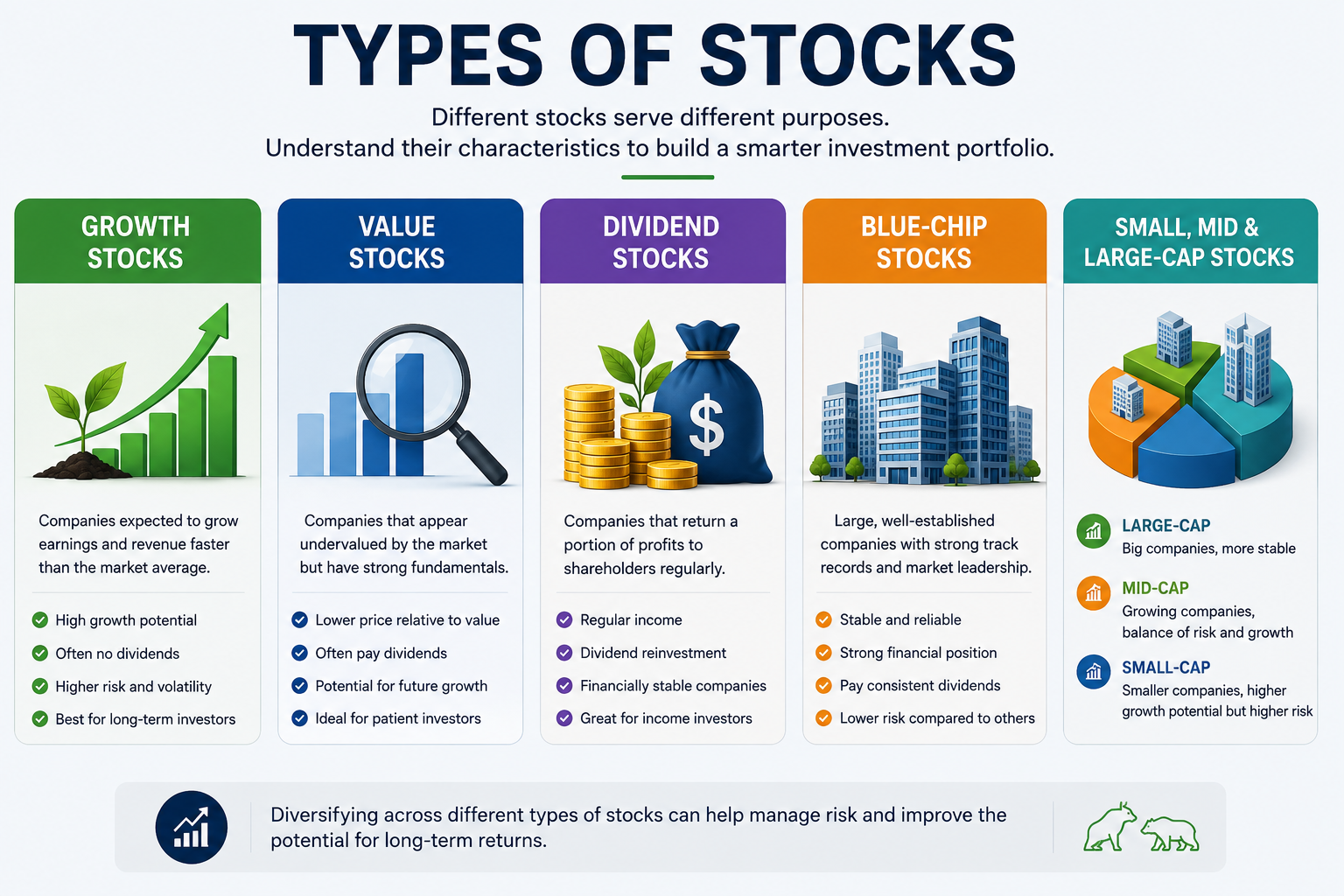
Not all stocks are the same. Companies vary in size, industry, growth potential, and how they return value to shareholders. Understanding the different categories of stocks can help investors build a diversified portfolio that aligns with their financial goals and risk tolerance.
Some investors seek companies with rapid growth potential, while others prefer businesses that pay regular dividends or have a long history of stability. Each type of stock serves a different purpose in an investment portfolio.
Common Stocks vs. Preferred Stocks
Common Stocks
Common stocks are the most widely traded type of shares. Investors who own common stock may benefit from increases in share price and may receive dividend payments if the company chooses to distribute profits.
- Voting rights at shareholder meetings.
- Potential for long-term capital appreciation.
- May receive dividends.
- Higher risk than preferred shares.
Preferred Stocks
Preferred stocks generally pay fixed dividends and usually receive dividend payments before common shareholders. However, preferred shareholders often have limited or no voting rights.
- Priority dividend payments.
- More stable income.
- Usually lower growth potential.
- Typically less volatile than common stocks.
Growth Stocks
Growth stocks are companies expected to increase their earnings and revenue faster than the overall market. These businesses often reinvest profits into expansion instead of paying dividends.
Characteristics of Growth Stocks
- Rapid business expansion
- Higher revenue growth
- Often little or no dividends
- Higher long-term return potential
- Can experience larger price swings

Value Stocks
Value stocks are companies that investors believe are trading below their intrinsic value. These businesses may be temporarily overlooked by the market despite having strong fundamentals.
Many long-term investors search for value stocks because they hope the market will eventually recognize the company's true worth.
Characteristics of Value Stocks
- Lower price relative to earnings.
- Established businesses.
- Potential for long-term appreciation.
- Often pay dividends.
- May recover after temporary setbacks.
Dividend Stocks
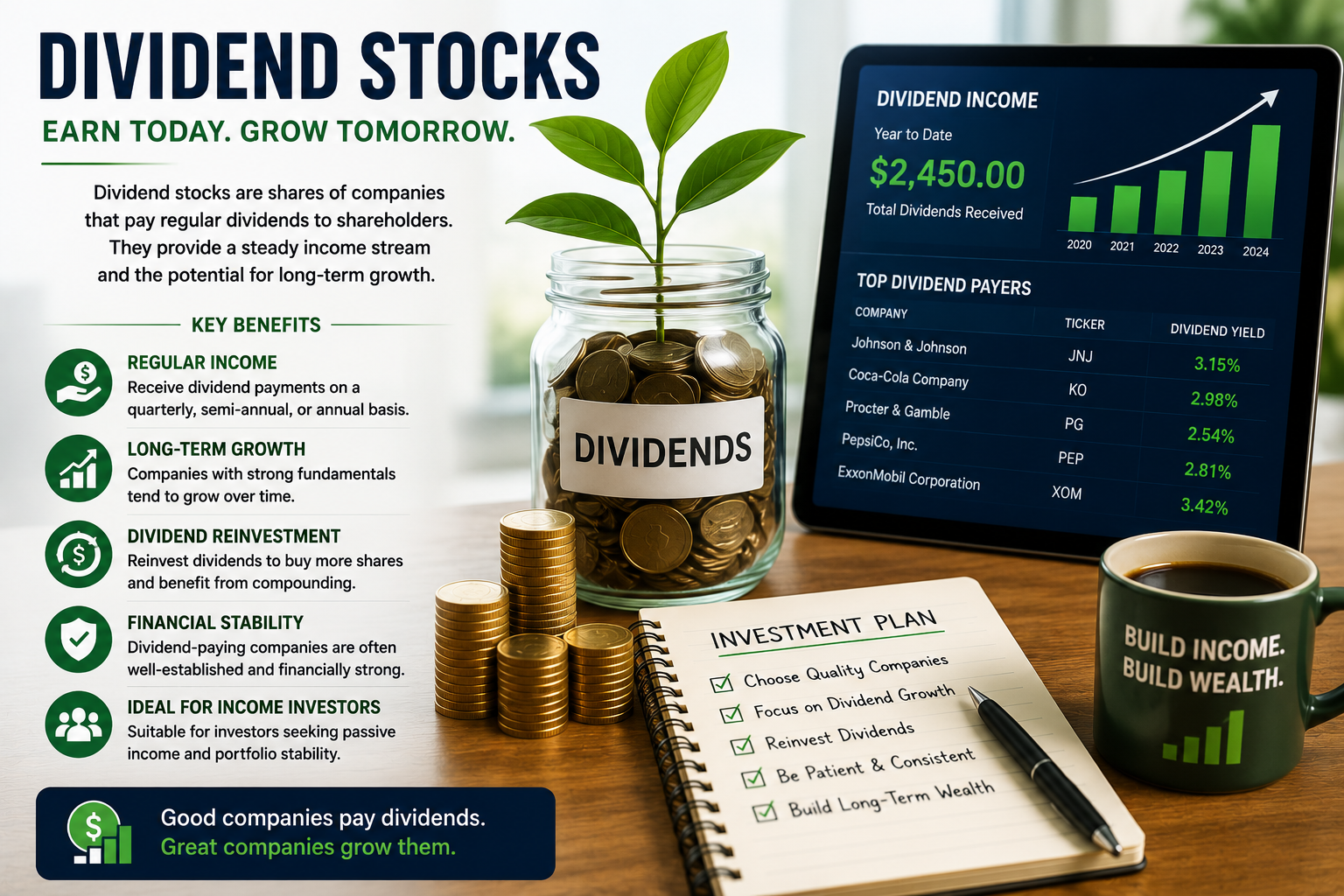
Dividend stocks regularly distribute a portion of company profits to shareholders. Many investors choose dividend-paying companies because they provide a stream of income in addition to potential share price growth.
Reinvesting dividends can significantly increase long-term investment returns through compounding.
Benefits of Dividend Stocks
- Regular passive income.
- Potential for long-term growth.
- Dividend reinvestment opportunities.
- Often financially stable companies.
- Suitable for income-focused investors.
Blue-Chip Stocks
Blue-chip stocks are shares of large, well-established companies with strong financial performance and long operating histories. These businesses often have recognizable brands and are considered among the more stable investments in the stock market.
While no investment is risk-free, blue-chip companies have often demonstrated resilience during changing economic conditions.
Characteristics of Blue-Chip Stocks
- Large market capitalization.
- Strong financial position.
- Established global brands.
- Reliable earnings history.
- Many pay regular dividends.
Large-Cap, Mid-Cap and Small-Cap Stocks
Stocks are also grouped according to market capitalization, which represents the total value of a company's outstanding shares.
Large-Cap Stocks
- Largest companies.
- Generally more stable.
- Often global businesses.
Mid-Cap Stocks
- Growing businesses.
- Balance between growth and stability.
- Moderate investment risk.
Small-Cap Stocks
- Smaller developing companies.
- Higher growth potential.
- Higher volatility and risk.
How to Start Investing in Stocks
Getting started with stock investing is easier than many people think. With today's online brokerage platforms, investors can begin building a portfolio with relatively small amounts of money. The key is to have a clear financial goal, understand your risk tolerance, and invest consistently over time.
Before purchasing your first stock, take time to learn how the market works, research companies, and develop a long-term investment strategy. Successful investing is generally based on patience, discipline, and informed decision-making rather than trying to predict short-term market movements.
Steps to Begin Investing
- Define your investment goals.
- Create an emergency savings fund.
- Choose a reputable brokerage platform.
- Research companies before investing.
- Diversify your investments.
- Invest consistently over time.
- Review your portfolio periodically.

Risks of Investing in Stocks
Although stocks have historically produced attractive long-term returns, they also carry risks. Prices can rise and fall due to company performance, economic conditions, interest rates, inflation, geopolitical events, and investor sentiment.
Understanding these risks helps investors make informed decisions and avoid emotional reactions during periods of market volatility.
Common Investment Risks
- Market risk
- Company-specific risk
- Economic downturns
- Inflation risk
- Interest rate changes
- Liquidity risk
- Currency risk for international investments
Tips for Beginner Stock Investors
Many successful investors follow simple principles rather than chasing the latest market trends. Consistency, diversification, and long-term thinking often prove more valuable than attempting to time the market.
Helpful Investing Tips
- Invest for the long term.
- Diversify across industries.
- Avoid emotional buying and selling.
- Continue learning about investing.
- Review company fundamentals.
- Reinvest dividends when appropriate.
- Invest only money you can leave invested.
- Keep investment costs low.
Frequently Asked Questions
Is investing in stocks risky?
Yes. Stock prices can rise and fall, and there is no guarantee of profit. However, many investors reduce risk through diversification and long-term investing.
How much money do I need to start?
Many brokerage platforms allow investors to start with relatively small amounts through fractional shares or low minimum investment requirements.
Should beginners buy individual stocks?
Some beginners choose diversified investments such as index funds or ETFs before selecting individual stocks, but the best approach depends on individual goals and risk tolerance.
How long should I hold stocks?
Many investors view stock investing as a long-term strategy and hold investments for several years or even decades.
Can I lose all my money?
Individual companies can fail, which is why diversification is important. Investing across multiple companies and sectors can reduce overall portfolio risk.
Have questions about investing in stocks? Share your thoughts, experiences, or beginner tips in the comments below. Community discussions help everyone learn and make better investment decisions.