
ETF Investing Explained: A Complete Beginner's Guide to Building a Diversified Portfolio
Learn how Exchange-Traded Funds (ETFs) work, why they have become one of the most popular investment options worldwide, and how beginners can use them to build diversified, low-cost investment portfolios for long-term financial growth.
Disclosure: Ads are displayed on this site. The information provided is for educational purposes only and should not be considered financial or investment advice.
Key Takeaways
- What Is an ETF? — Understand how Exchange-Traded Funds work.
- Benefits of ETFs — Discover why ETFs are popular among investors.
- Types of ETFs — Learn about stock, bond, sector, commodity, and international ETFs.
- ETF Fees — Understand expense ratios and investing costs.
- Risks — Learn the potential risks of ETF investing.
- Getting Started — Simple steps for beginners to begin investing in ETFs.
Exchange-Traded Funds, commonly known as ETFs, have transformed the way millions of people invest. Instead of purchasing individual stocks or bonds one at a time, investors can buy a single ETF that holds dozens, hundreds, or even thousands of investments within one fund.
ETFs are widely appreciated because they combine diversification, relatively low costs, flexibility, and ease of trading. Whether you're investing for retirement, generating passive income, preserving wealth, or pursuing long-term growth, ETFs can play an important role in an investment strategy.
At Go-Superscribe, our goal is to make investing easy to understand. This guide explains ETF investing in simple language so beginners can build confidence before making investment decisions.
What Is an Exchange-Traded Fund (ETF)?
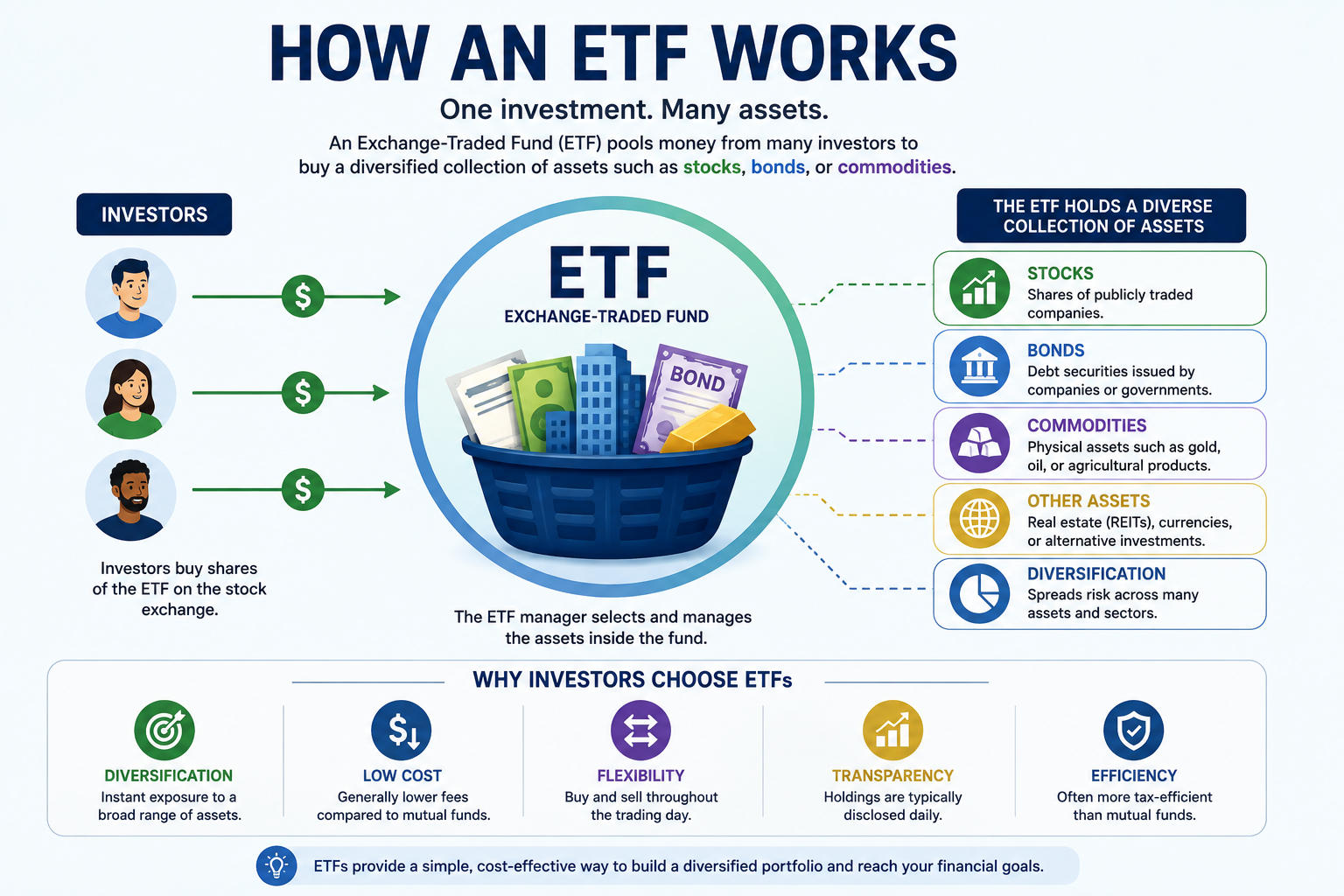
An Exchange-Traded Fund (ETF) is a type of investment fund that holds a collection of assets such as stocks, bonds, commodities, or other securities. Instead of buying each investment individually, investors purchase shares of the ETF, giving them exposure to the entire portfolio.
ETFs are traded on stock exchanges throughout the trading day, just like individual company shares. Their prices change continuously as investors buy and sell them during market hours.
Most ETFs are designed to track the performance of a specific market index, industry sector, commodity, or investment strategy. Others are actively managed by professional fund managers who select investments based on specific objectives.
Why ETFs Have Become So Popular
ETFs have experienced tremendous growth because they make investing simpler and more affordable. Instead of researching and buying dozens of individual securities, investors can purchase one ETF and instantly gain broad market exposure.
This convenience has made ETFs one of the fastest-growing investment products in the world, serving everyone from first-time investors to large institutional investment firms.
Benefits of ETF Investing
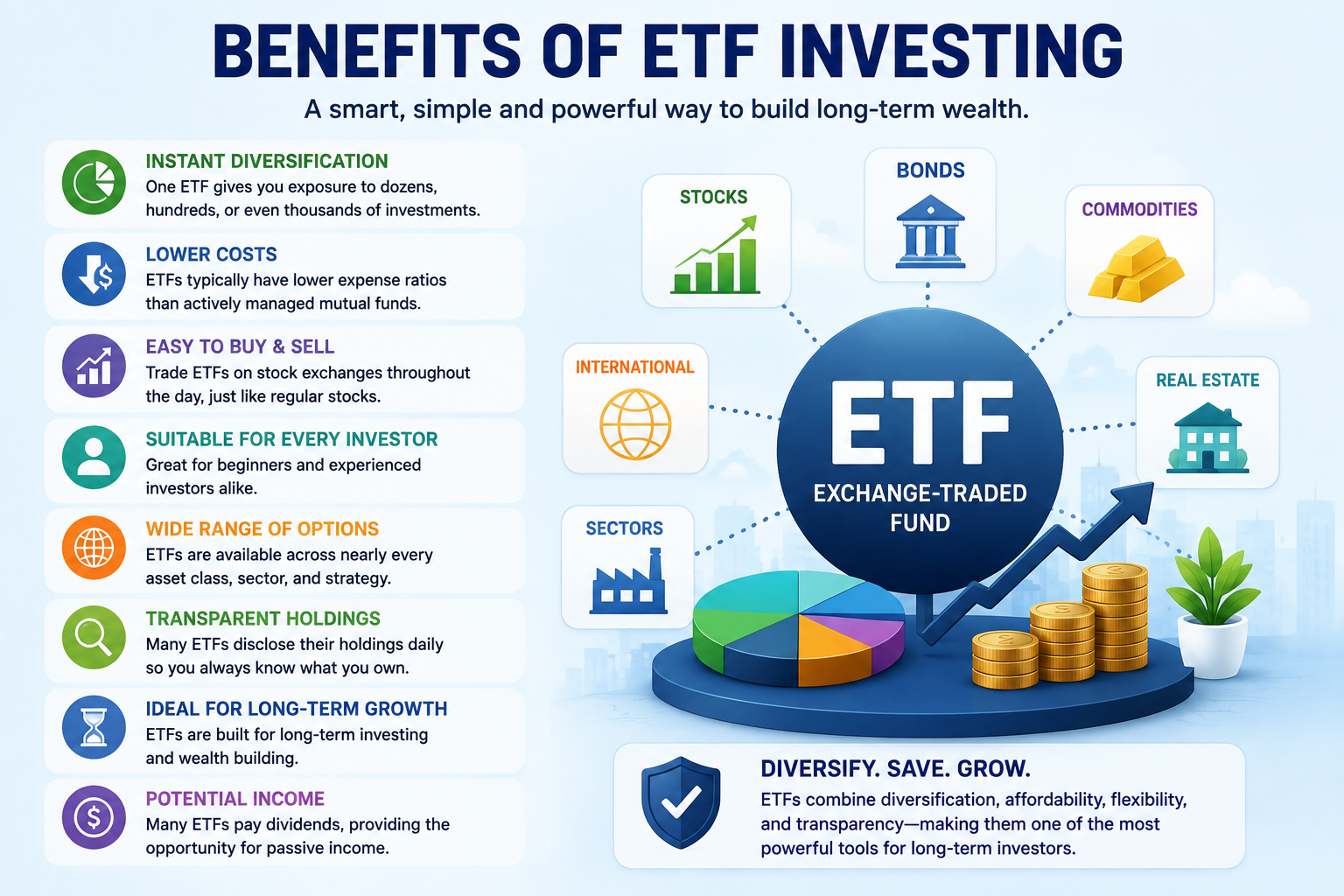
Exchange-Traded Funds have become one of the fastest-growing investment products because they combine simplicity, affordability, and diversification. Instead of selecting dozens of individual investments, investors can purchase a single ETF and gain exposure to an entire market, industry, or asset class.
Whether you're investing for retirement, building long-term wealth, or creating passive income, ETFs offer an accessible way to participate in financial markets while reducing many of the risks associated with investing in only a few individual securities.
Key Benefits of ETFs
- Instant diversification across many investments
- Generally lower fees than many actively managed mutual funds
- Easy to buy and sell on stock exchanges
- Suitable for beginners and experienced investors
- Available across nearly every asset class
- Transparent holdings in many ETFs
- Excellent for long-term investing
- Can generate dividend income depending on the ETF
How ETFs Work
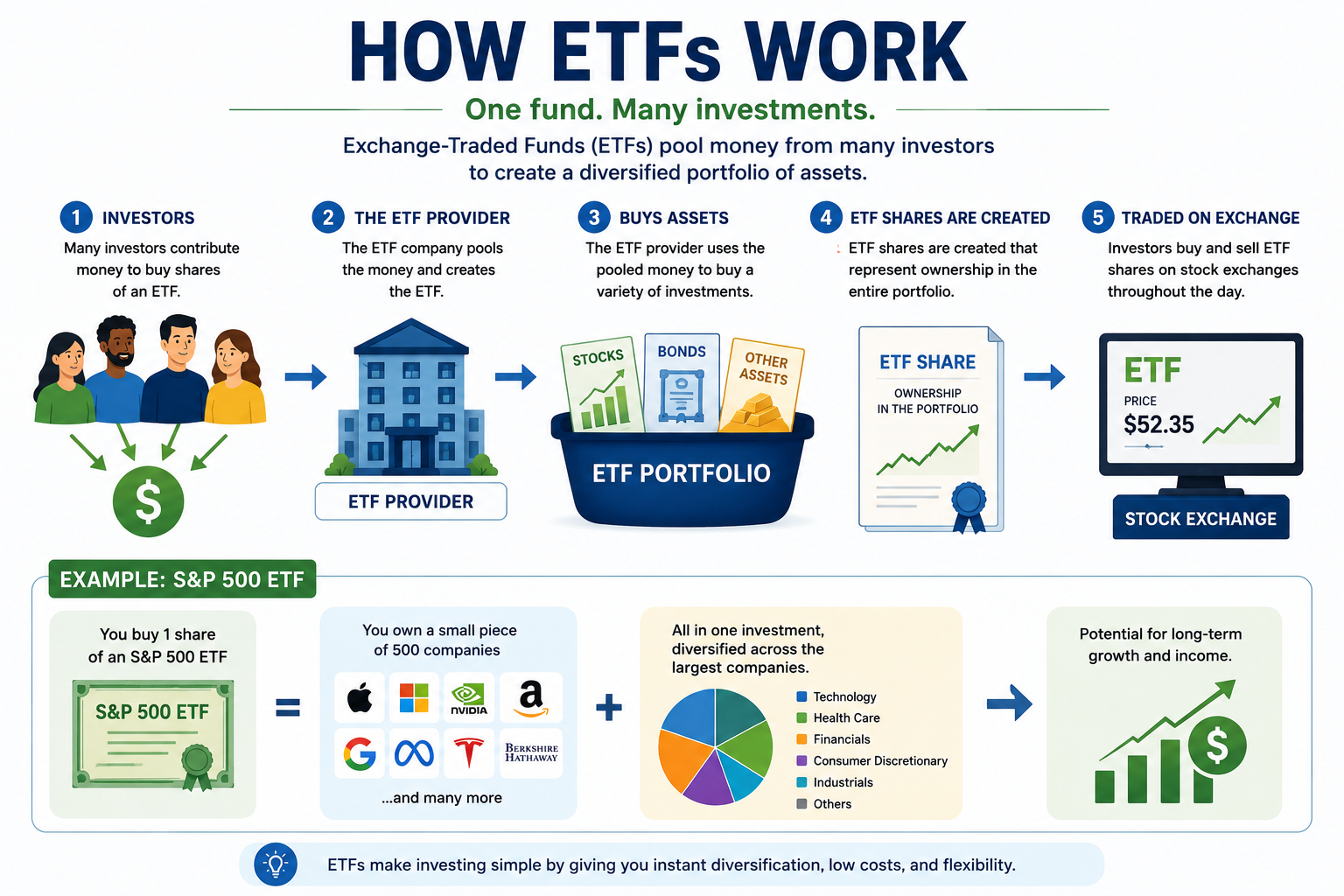
An ETF pools money from thousands or even millions of investors. Professional fund managers use that money to purchase a collection of investments according to the ETF's objective.
For example, an S&P 500 ETF buys shares of companies that make up the S&P 500 Index. Instead of purchasing shares in every company individually, investors simply buy one ETF share and instantly own a small portion of the entire portfolio.
Because ETFs trade on stock exchanges throughout the day, investors can buy or sell shares whenever markets are open, just like ordinary company stocks.
Understanding ETF Creation and Redemption
Unlike ordinary stocks, new ETF shares can be created or removed from the market. Large financial institutions known as Authorized Participants work with ETF providers to create new ETF shares when investor demand increases or redeem shares when demand falls.
This unique creation and redemption process helps keep ETF prices close to the actual value of the investments held inside the fund.
Why This Matters
- Helps maintain fair market pricing
- Keeps ETFs highly liquid
- Reduces large price differences between market price and asset value
- Makes ETFs efficient investment vehicles
What Is Net Asset Value (NAV)?
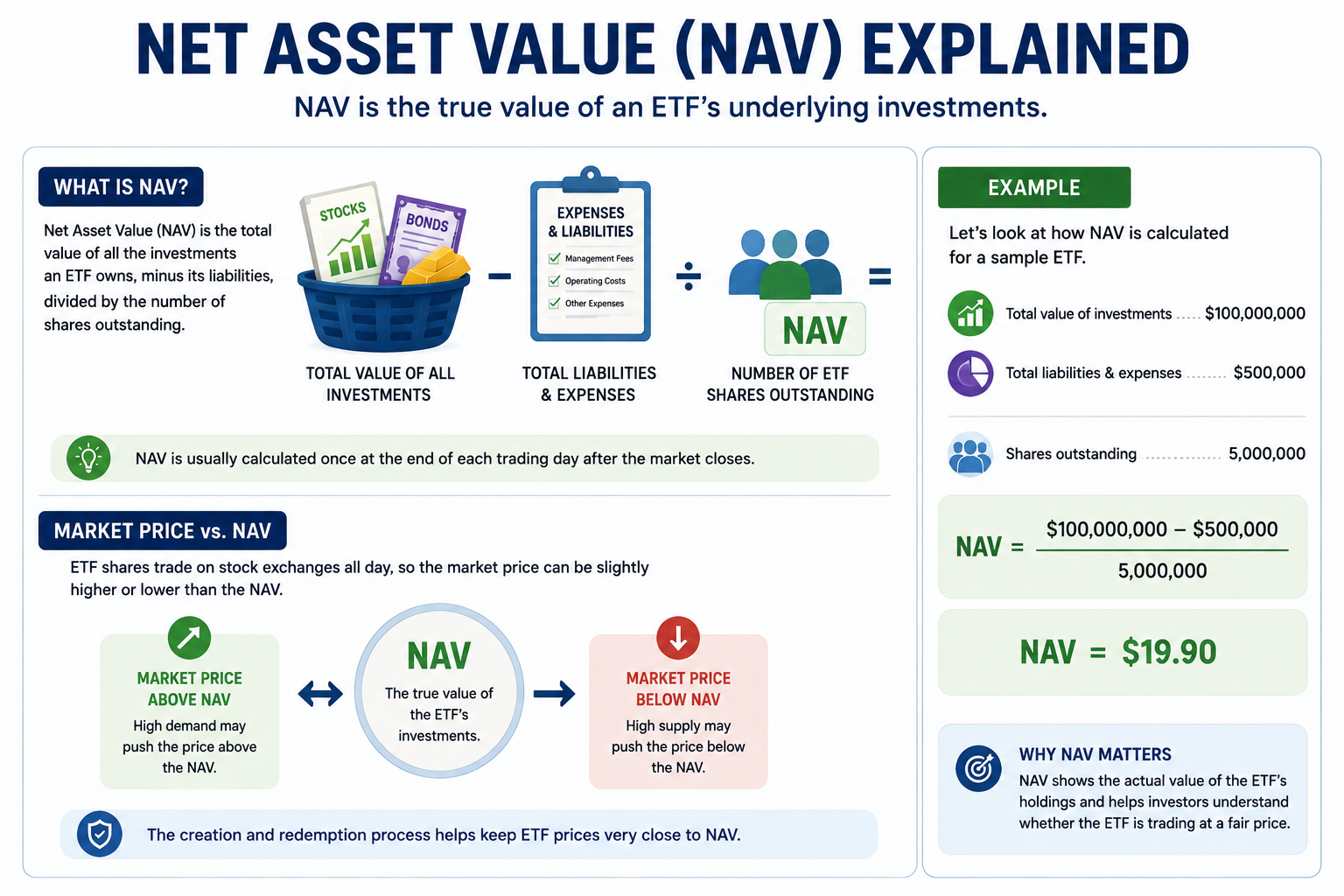
Net Asset Value, often called NAV, represents the total value of all investments owned by an ETF after deducting expenses and liabilities. It is usually calculated at the end of each trading day.
Although ETF shares trade throughout the day, their market prices generally stay very close to their Net Asset Value because of the creation and redemption process.
Why ETF Prices Change
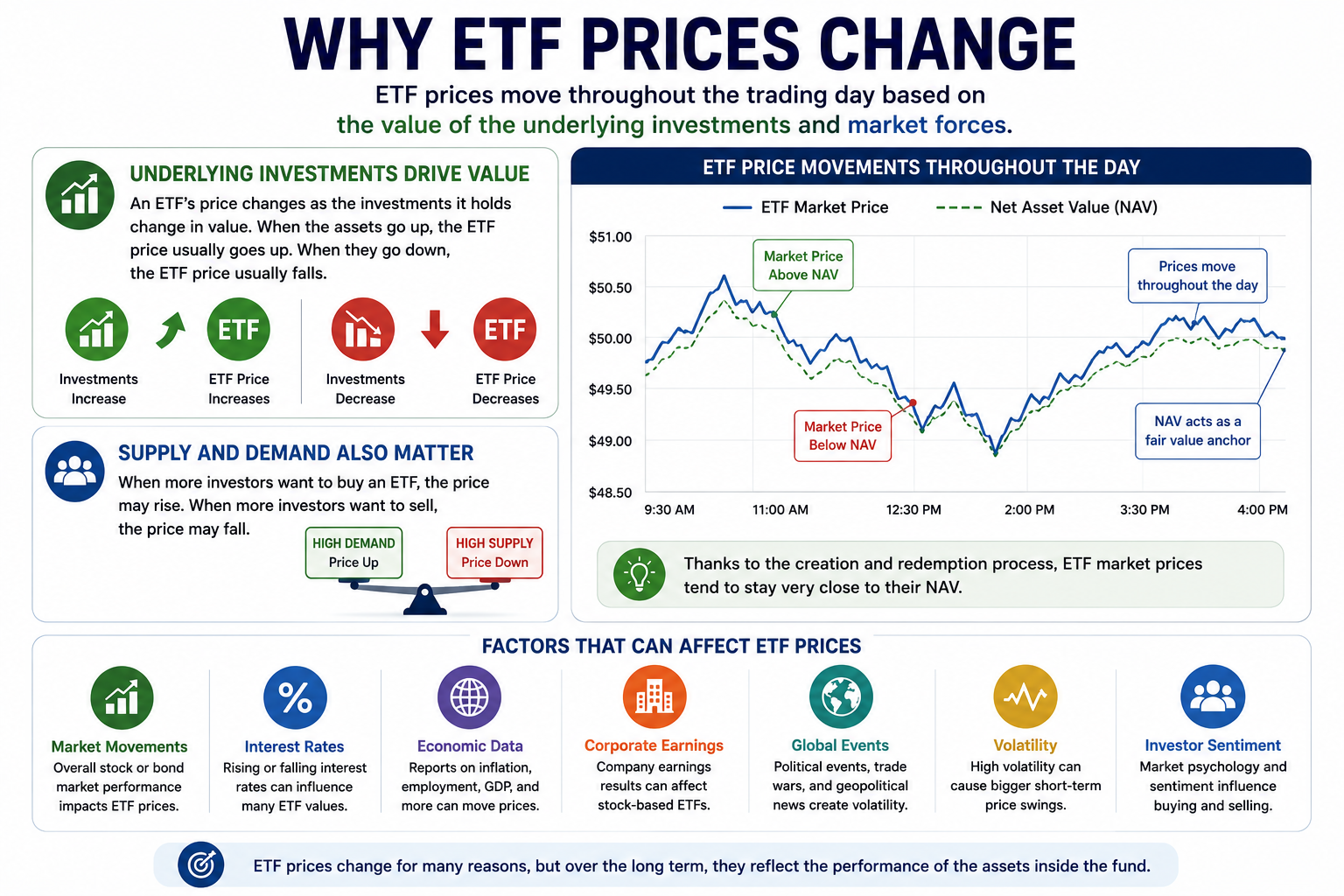
ETF prices fluctuate throughout the trading day because the value of the underlying investments changes continuously. If the stocks, bonds, or commodities held by the ETF increase in value, the ETF price usually rises as well. Likewise, if those investments decline, the ETF's price generally falls.
Supply and demand also influence ETF prices. During periods of heavy buying or selling, ETF prices may temporarily move slightly above or below their Net Asset Value before market forces bring them back into alignment.
Factors That Affect ETF Prices
- Changes in the value of underlying investments
- Interest rate movements
- Economic conditions
- Corporate earnings
- Inflation expectations
- Global political events
- Investor sentiment
- Market volatility
Types of Exchange-Traded Funds (ETFs)
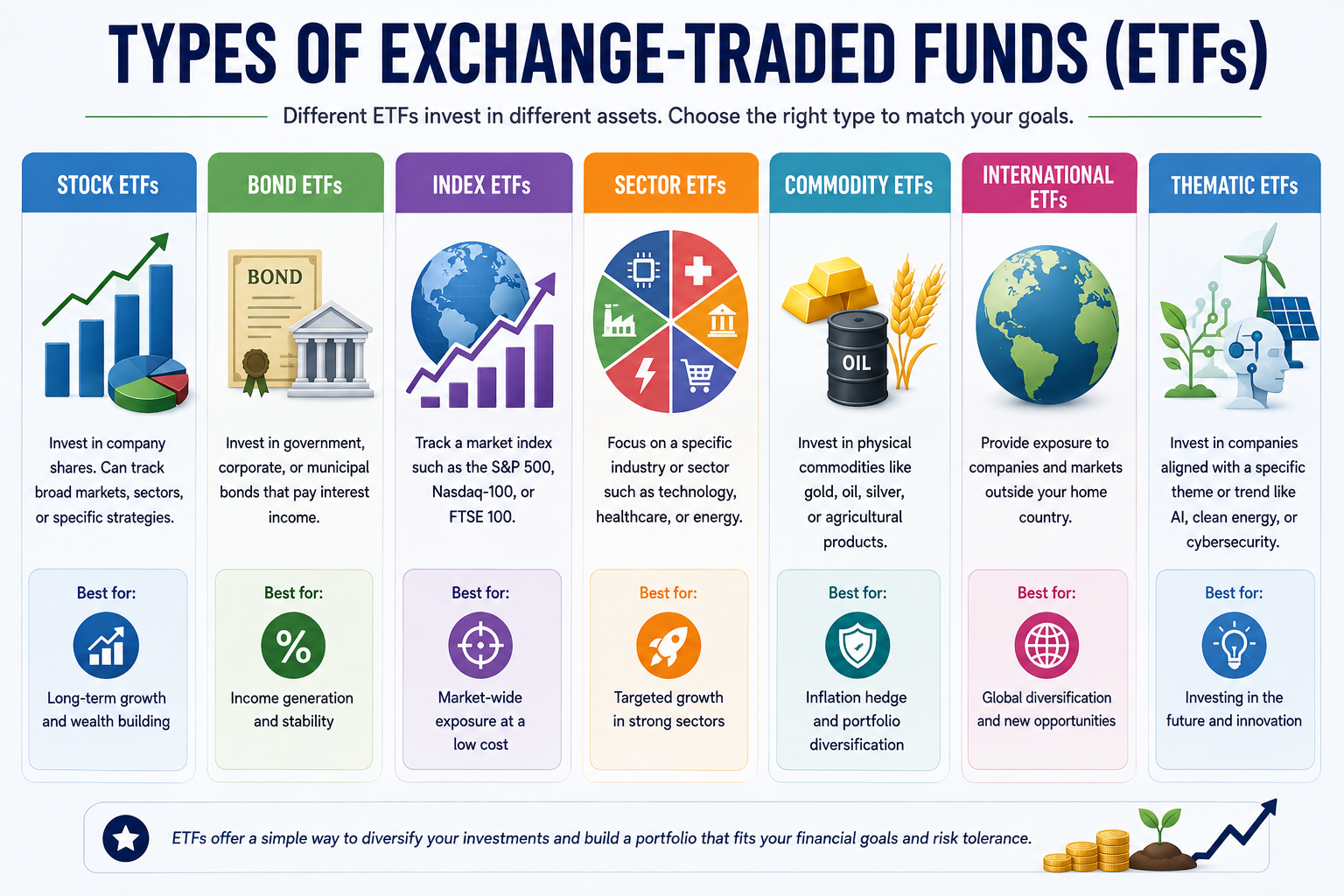
Not all ETFs invest in the same assets. Some focus on stocks, others invest in bonds, while some track commodities, international markets, or specific industries. Understanding the different types of ETFs helps investors choose funds that match their financial goals, risk tolerance, and investment strategy.
Whether you want long-term growth, regular income, global diversification, or protection during uncertain market conditions, there is likely an ETF designed to meet your needs.
Stock ETFs
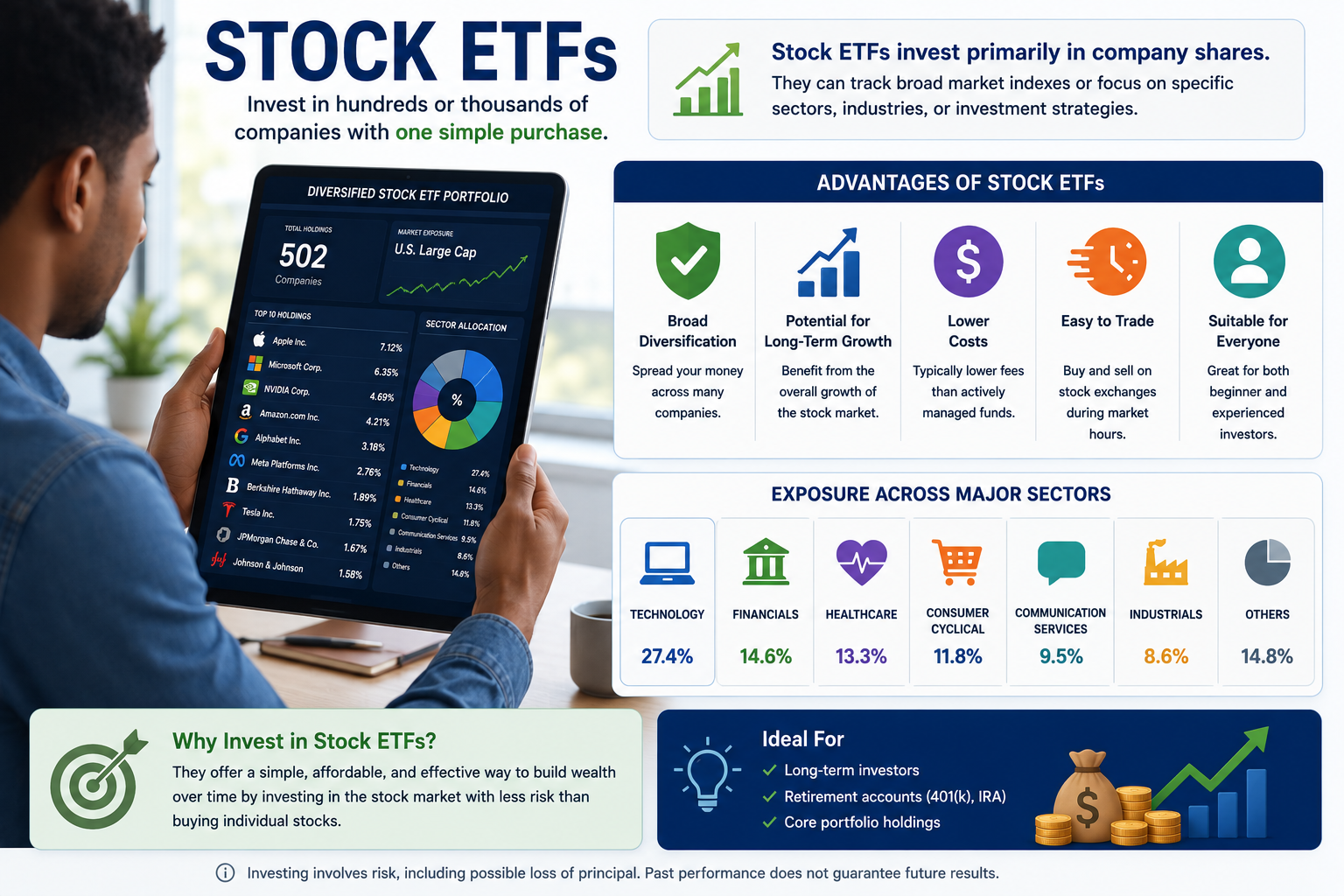
Stock ETFs invest primarily in company shares and are among the most popular ETF categories. They can track broad market indexes such as the S&P 500 or focus on specific sectors like technology, healthcare, finance, or energy.
Rather than buying shares of dozens or hundreds of companies individually, investors purchase one ETF that already owns those companies, making diversification simple and affordable.
Advantages of Stock ETFs
- Broad diversification
- Potential for long-term capital growth
- Lower investment costs
- Easy to trade during market hours
- Suitable for beginner investors
Bond ETFs
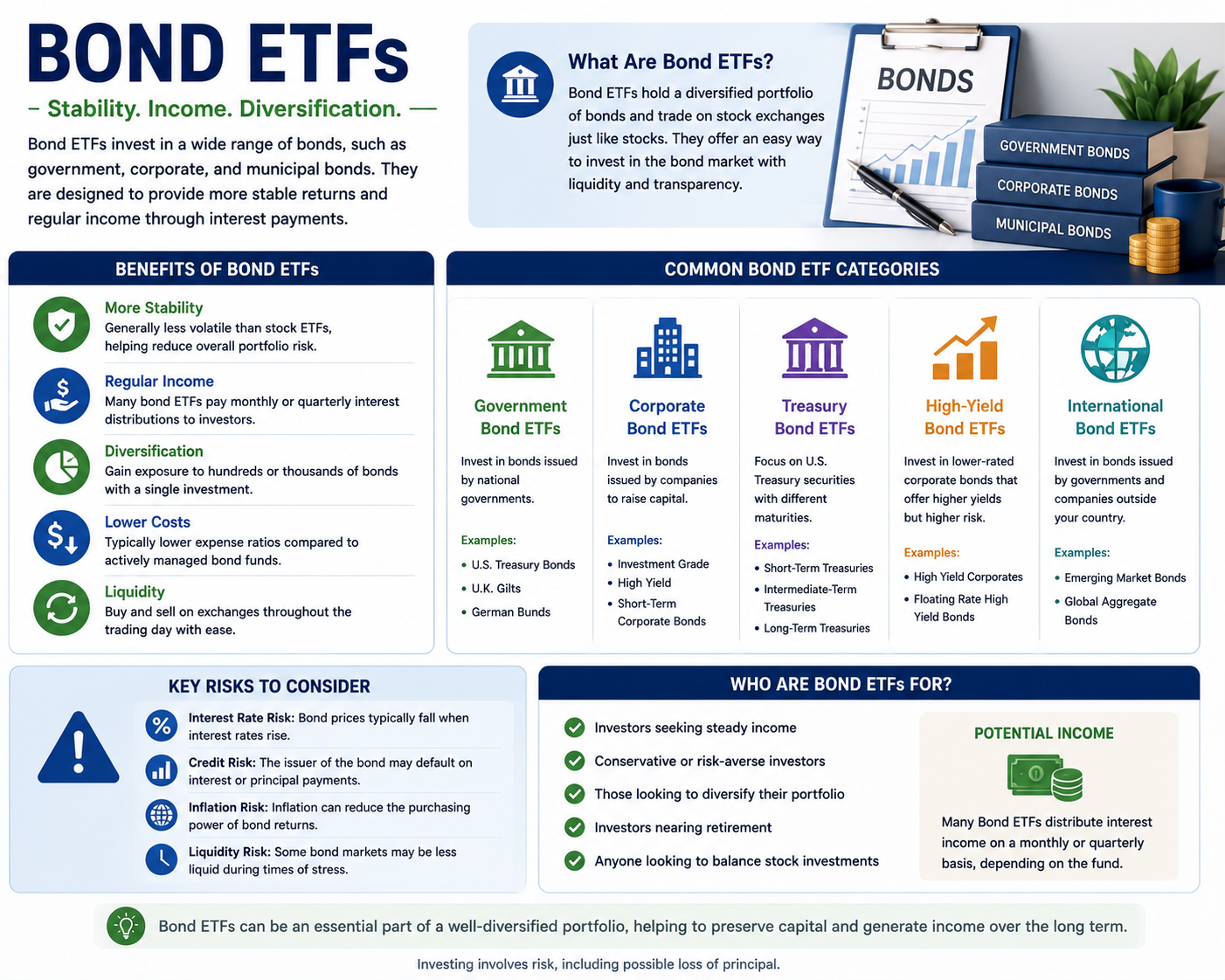
Bond ETFs invest in government bonds, municipal bonds, or corporate bonds. They are often used by investors seeking more stable returns and regular income through interest payments.
Although bond ETFs generally experience less volatility than stock ETFs, their prices can still fluctuate because of interest rate changes and overall market conditions.
Common Bond ETF Categories
- Government Bond ETFs
- Corporate Bond ETFs
- Treasury Bond ETFs
- High-Yield Bond ETFs
- International Bond ETFs
Index ETFs
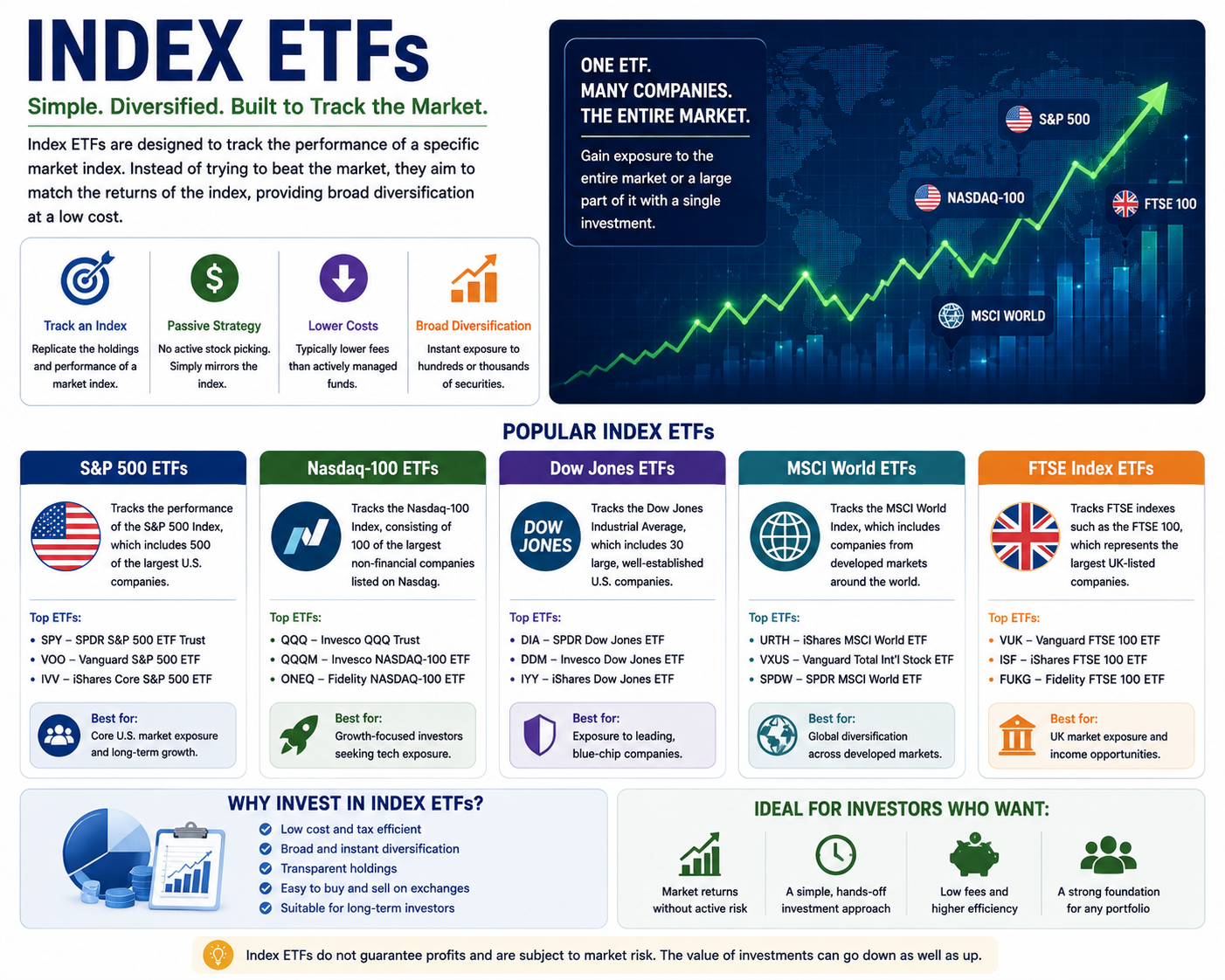
Index ETFs aim to replicate the performance of a specific market index. Instead of trying to outperform the market, these ETFs simply mirror the holdings of an index such as the S&P 500, Nasdaq-100, FTSE 100, or MSCI World Index.
Because they follow a passive investment strategy, index ETFs often have lower management fees than actively managed funds.
Popular Index ETFs
- S&P 500 ETFs
- Nasdaq-100 ETFs
- Dow Jones ETFs
- MSCI World ETFs
- FTSE Index ETFs
Sector ETFs
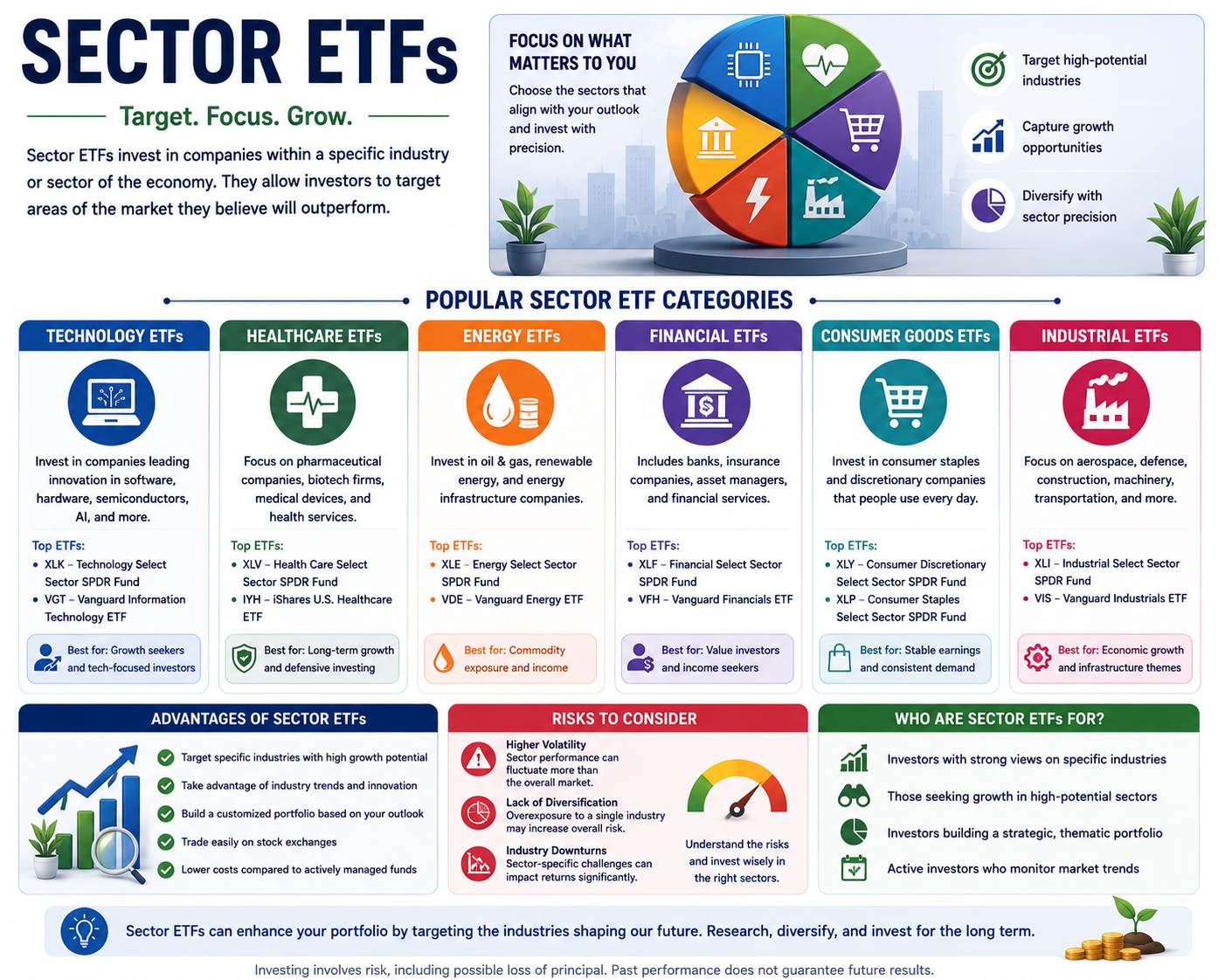
Sector ETFs focus on companies within a particular industry or sector of the economy. Instead of investing across the entire stock market, these ETFs allow investors to target industries they believe will outperform.
Sector investing can provide higher growth opportunities but may also involve greater risk because performance depends heavily on one industry.
Examples of Sector ETFs
- Technology ETFs
- Healthcare ETFs
- Energy ETFs
- Financial ETFs
- Consumer Goods ETFs
- Industrial ETFs
Commodity ETFs
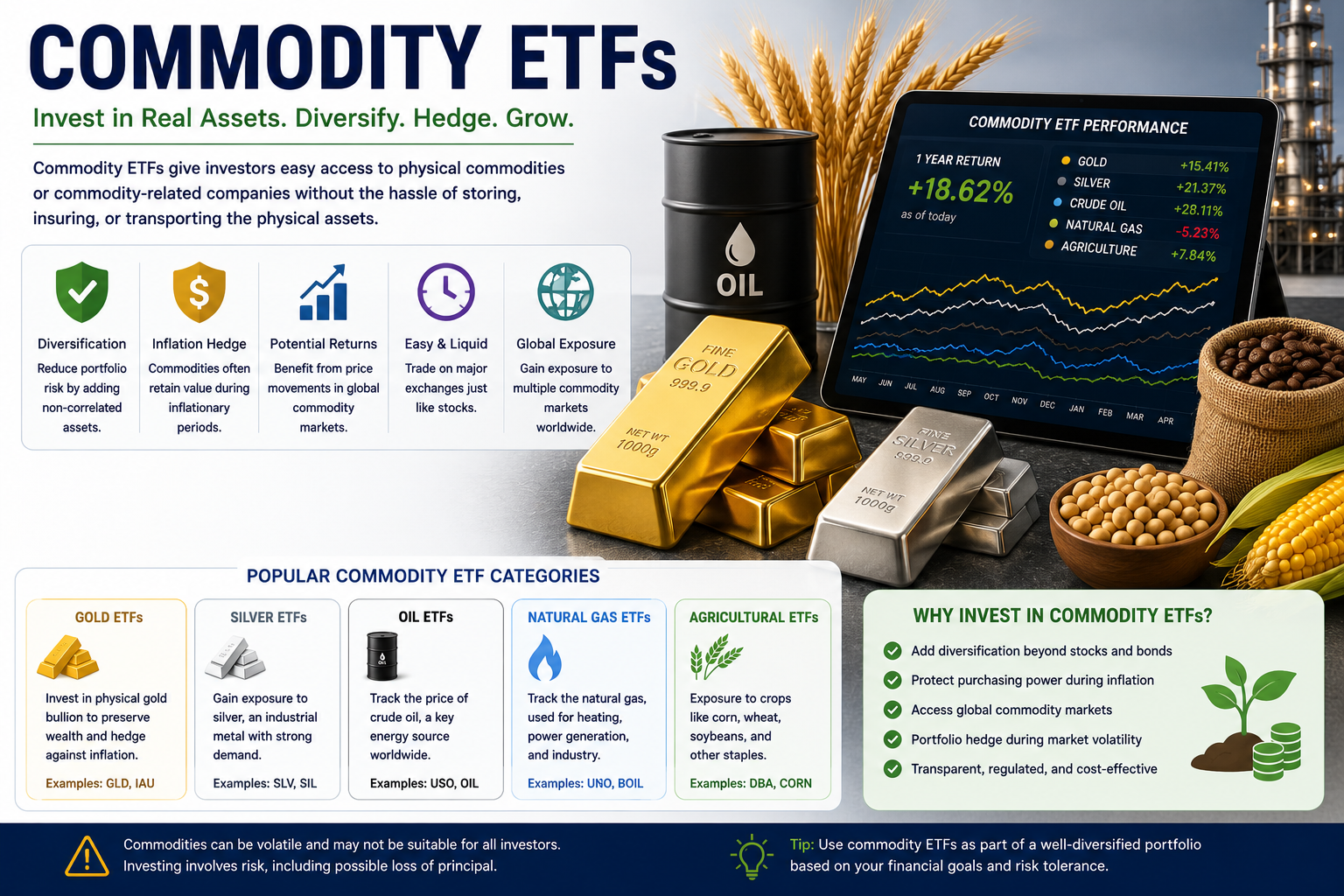
Commodity ETFs invest in physical commodities or commodity-related companies, giving investors exposure to assets such as gold, silver, oil, natural gas, and agricultural products without having to own the physical commodities themselves.
Many investors use commodity ETFs to diversify their portfolios or to help protect against inflation. Commodity prices can be highly volatile, so these ETFs may experience significant price fluctuations over short periods.
Popular Commodity ETF Categories
- Gold ETFs
- Silver ETFs
- Oil ETFs
- Natural Gas ETFs
- Agricultural Commodity ETFs
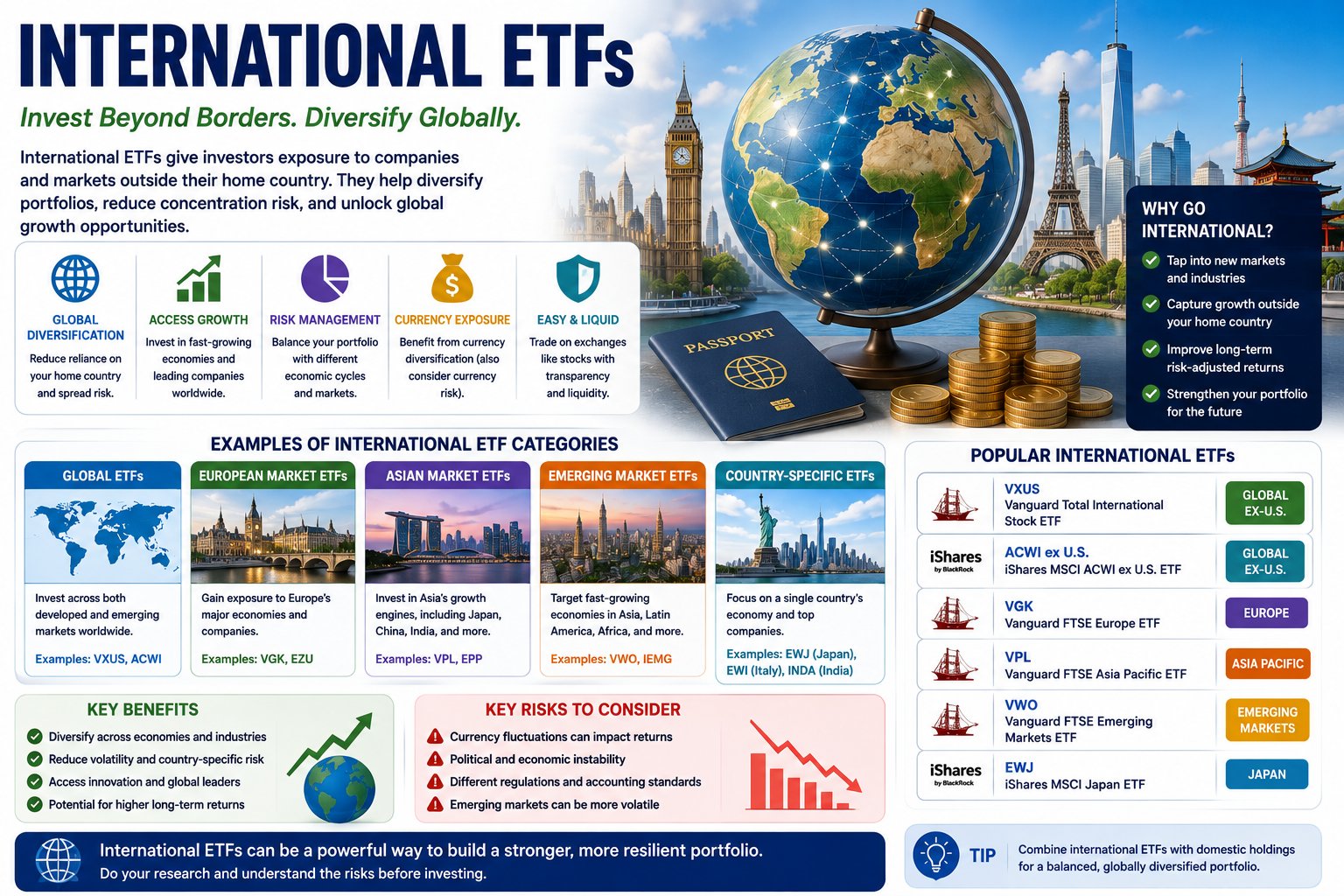
International ETFs
International ETFs allow investors to gain exposure to companies outside their home country. These funds may focus on developed markets, emerging markets, specific countries, or entire global regions.
International investing helps diversify a portfolio by reducing dependence on the performance of one country's economy. However, investors should also understand currency risk and geopolitical risks that may affect international investments.
Examples of International ETFs
- Global ETFs
- European Market ETFs
- Asian Market ETFs
- Emerging Market ETFs
- Country-Specific ETFs
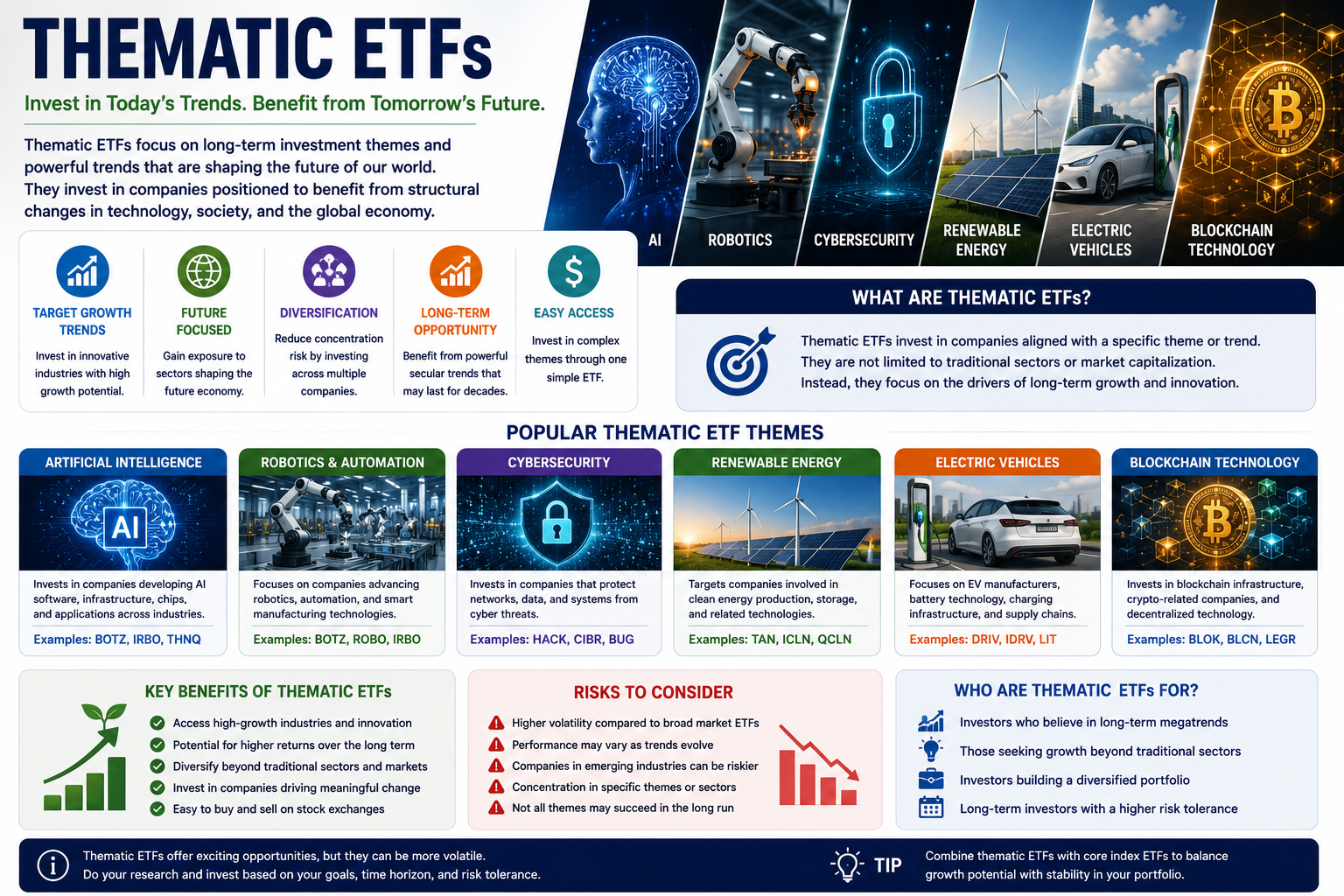
Thematic ETFs
Thematic ETFs invest in companies expected to benefit from long-term trends or emerging industries. Rather than tracking a traditional market index, these ETFs focus on a particular investment theme.
Popular themes include artificial intelligence, robotics, cybersecurity, renewable energy, electric vehicles, blockchain technology, and clean energy.
Popular Thematic ETF Themes
- Artificial Intelligence
- Robotics
- Cybersecurity
- Renewable Energy
- Electric Vehicles
- Blockchain Technology
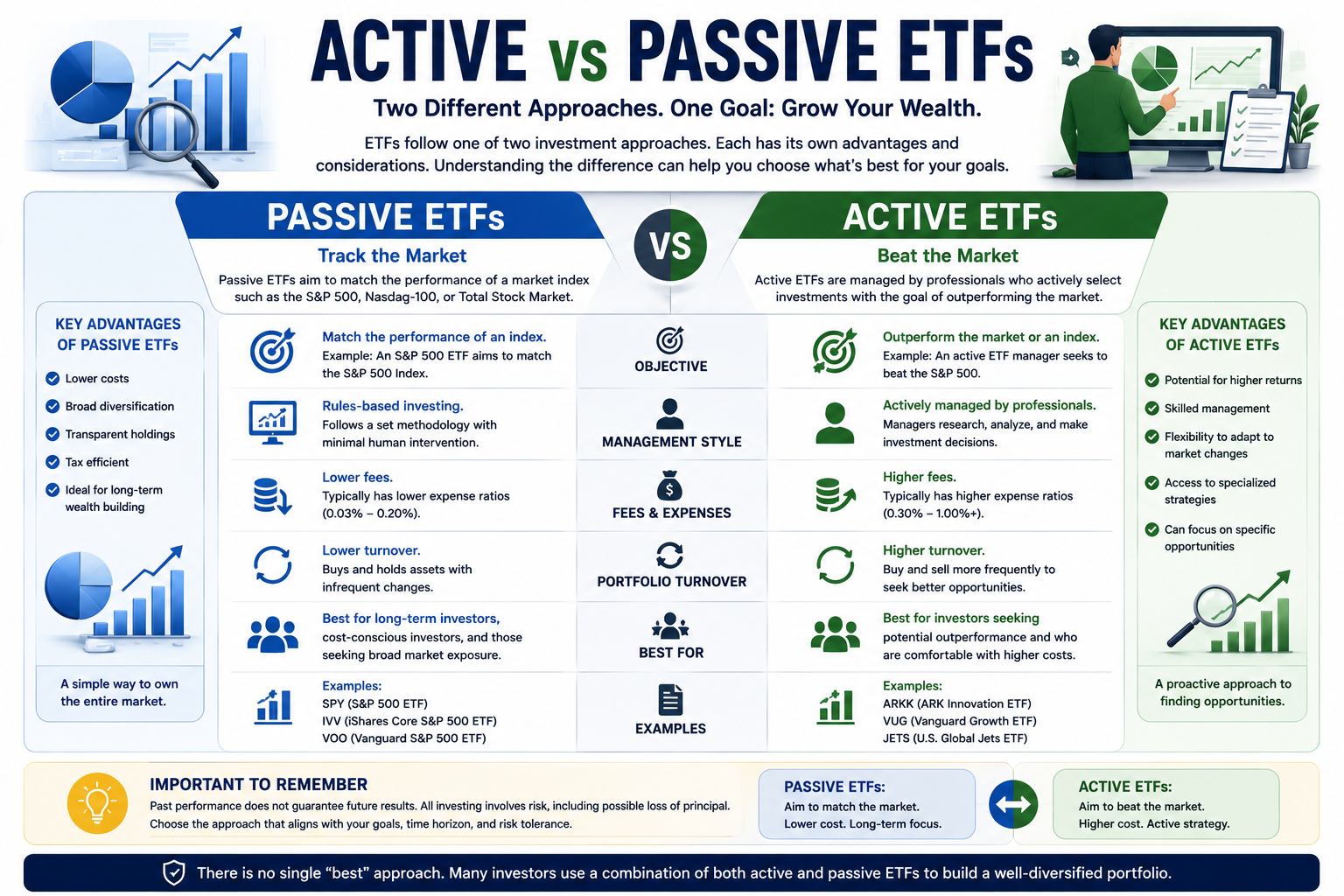
Active vs Passive ETFs
Most ETFs follow one of two investment approaches: passive investing or active investing.
Passive ETFs simply track a market index and aim to match its performance. They generally have lower fees because they require less active management.
Active ETFs are managed by professional portfolio managers who actively select investments with the goal of outperforming the market. Because of the additional research and management involved, active ETFs often charge higher expense ratios.
Passive ETFs
- Track a market index
- Lower management fees
- Broad market exposure
- Long-term investing strategy
Active ETFs
- Professionally managed
- Attempt to outperform the market
- Higher management costs
- May involve greater portfolio turnover
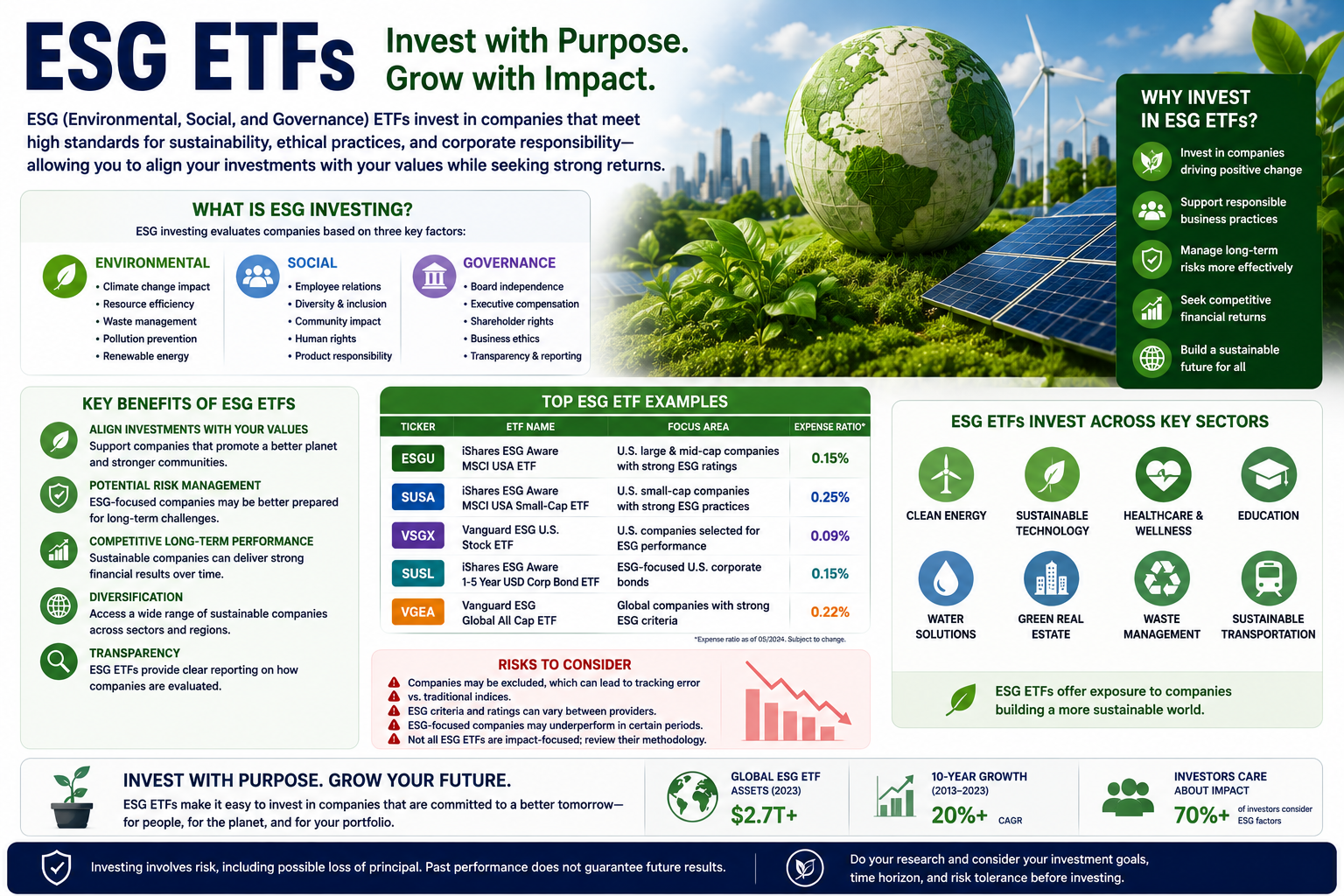
ESG ETFs
Environmental, Social, and Governance (ESG) ETFs invest in companies that meet specific sustainability and ethical standards. These funds appeal to investors who want their investments to align with their personal values while still seeking financial returns.
ESG ETFs evaluate companies based on factors such as environmental impact, labor practices, diversity, corporate governance, and business ethics.
Common ESG Investment Areas
- Clean Energy
- Sustainable Businesses
- Low Carbon Companies
- Corporate Governance
- Social Responsibility
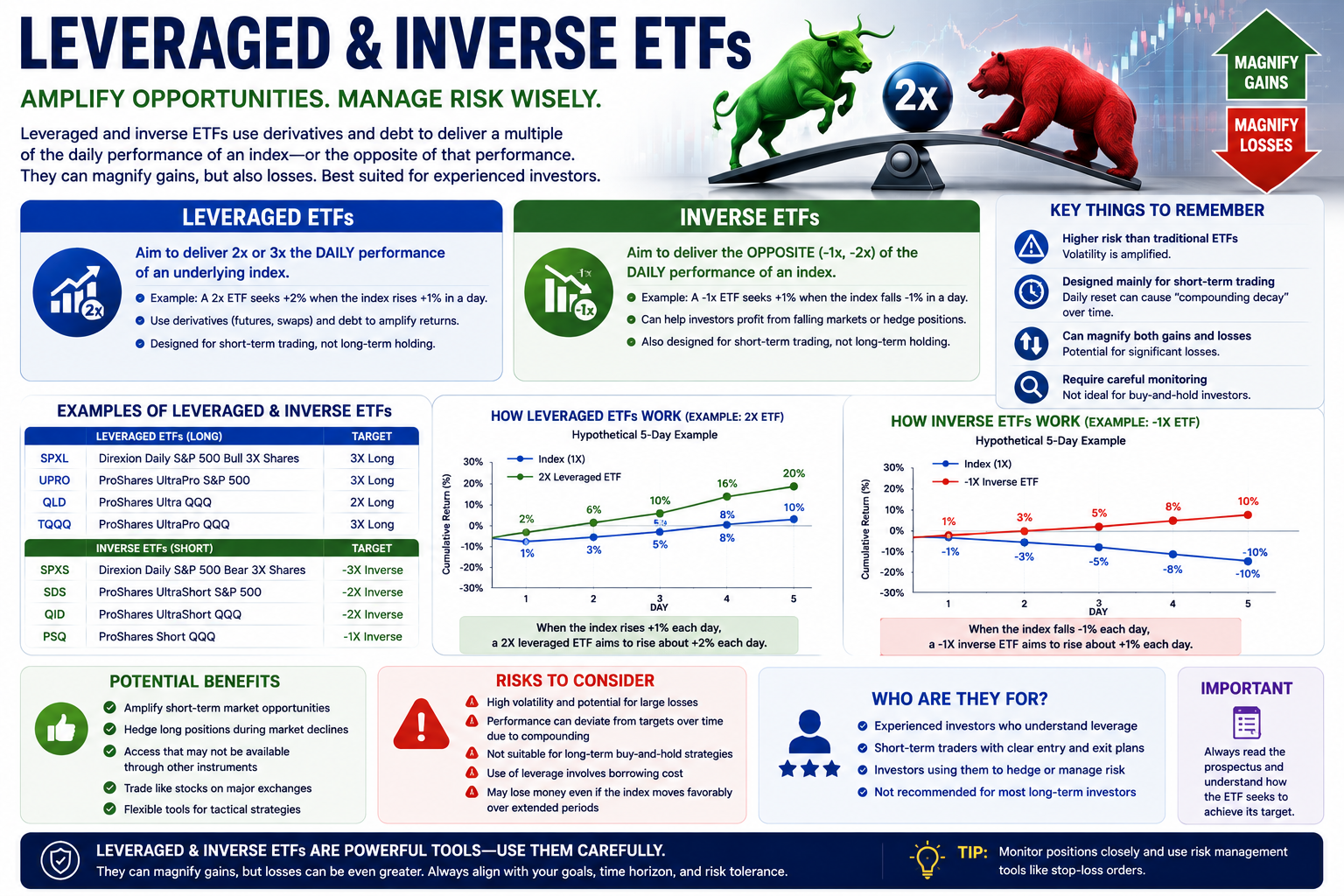
Leveraged and Inverse ETFs
Leveraged ETFs use financial instruments such as derivatives to amplify daily market returns. Some aim to produce two or three times the daily performance of an index.
Inverse ETFs attempt to move in the opposite direction of the market, allowing investors to potentially profit when markets decline.
These ETFs are generally designed for experienced investors because they involve higher risk, greater volatility, and are intended primarily for short-term trading rather than long-term investing.
Things to Remember
- Higher risk than traditional ETFs
- Designed mainly for short-term trading
- Can magnify both gains and losses
- Require careful monitoring
ETF Fees and Expense Ratios
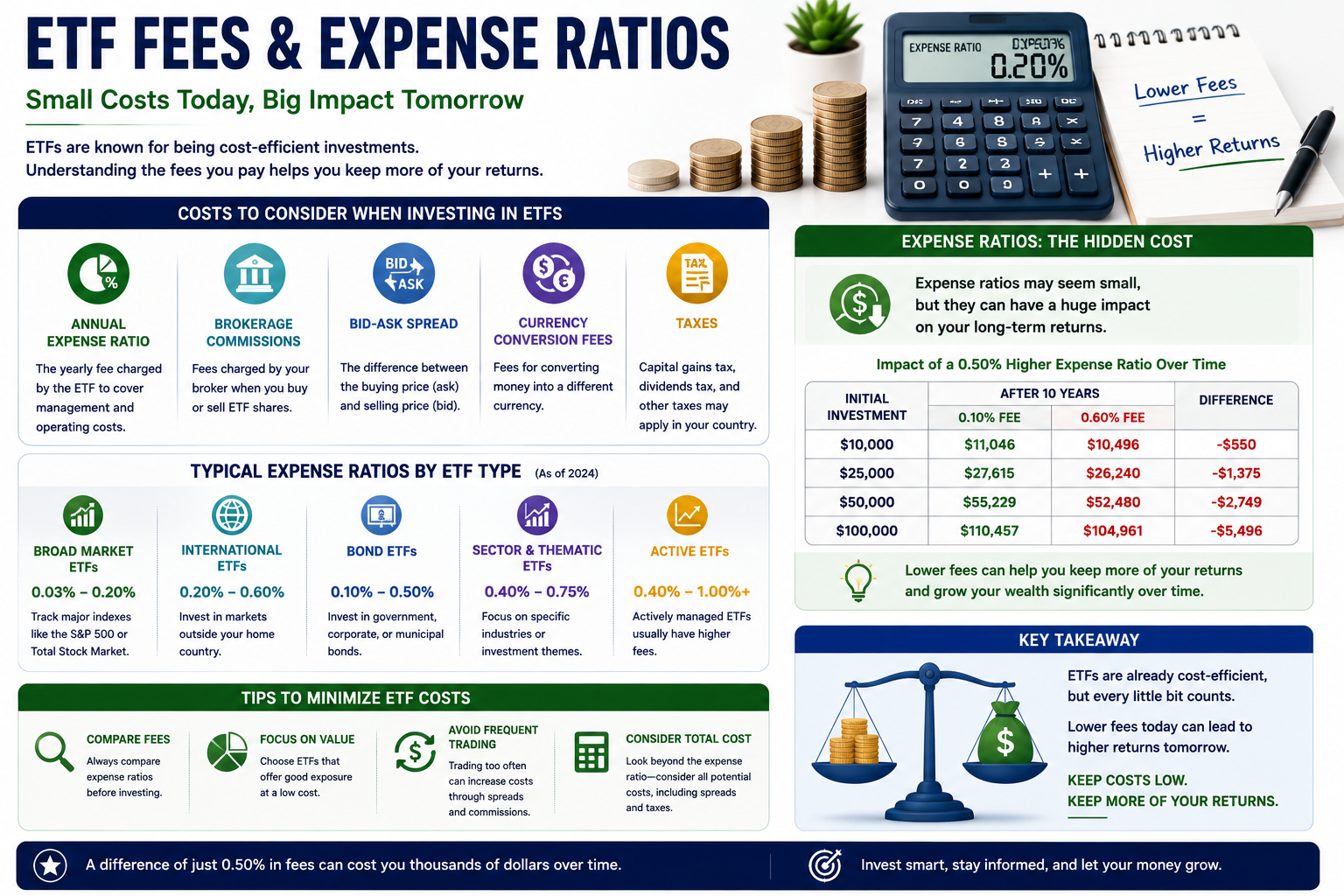
One of the biggest advantages of ETFs is their relatively low cost. Instead of paying high management fees, many ETFs charge a small annual expense ratio that is automatically deducted from the fund's assets.
Although expense ratios may seem small, they can have a significant impact on long-term investment returns. Comparing fees is an important step when selecting between similar ETFs.
Costs to Consider
- Annual expense ratio
- Brokerage commissions (if applicable)
- Bid-ask spread
- Currency conversion fees
- Taxes
Risks of Investing in ETFs
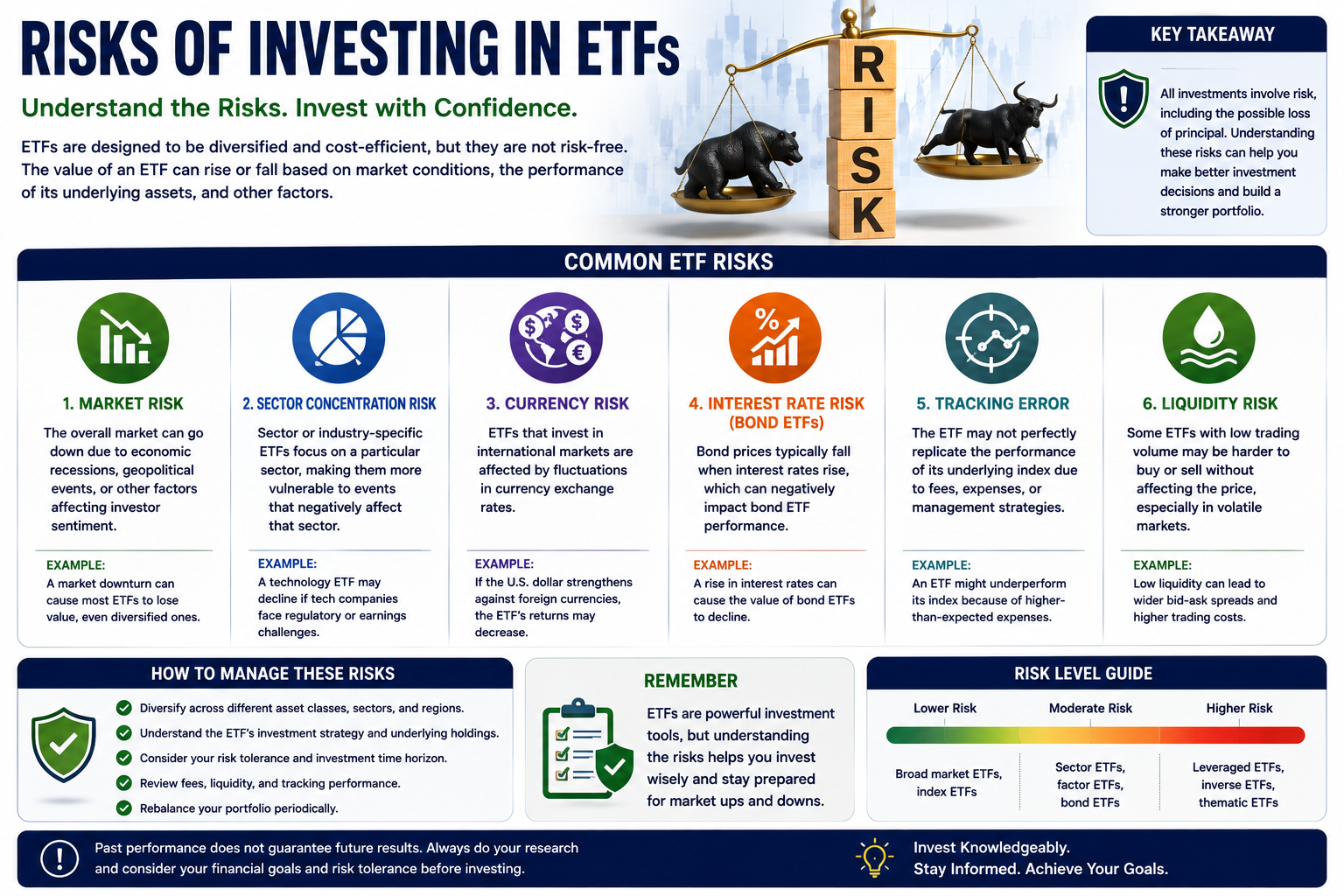
Although ETFs are widely considered an efficient investment vehicle, they still carry investment risks. The value of an ETF can rise or fall depending on the performance of its underlying investments and market conditions.
Understanding these risks helps investors make informed decisions and build portfolios that match their financial goals and risk tolerance.
Common ETF Risks
- Market risk
- Sector concentration risk
- Currency risk
- Interest rate risk (bond ETFs)
- Tracking error
- Liquidity risk
How to Choose the Right ETF
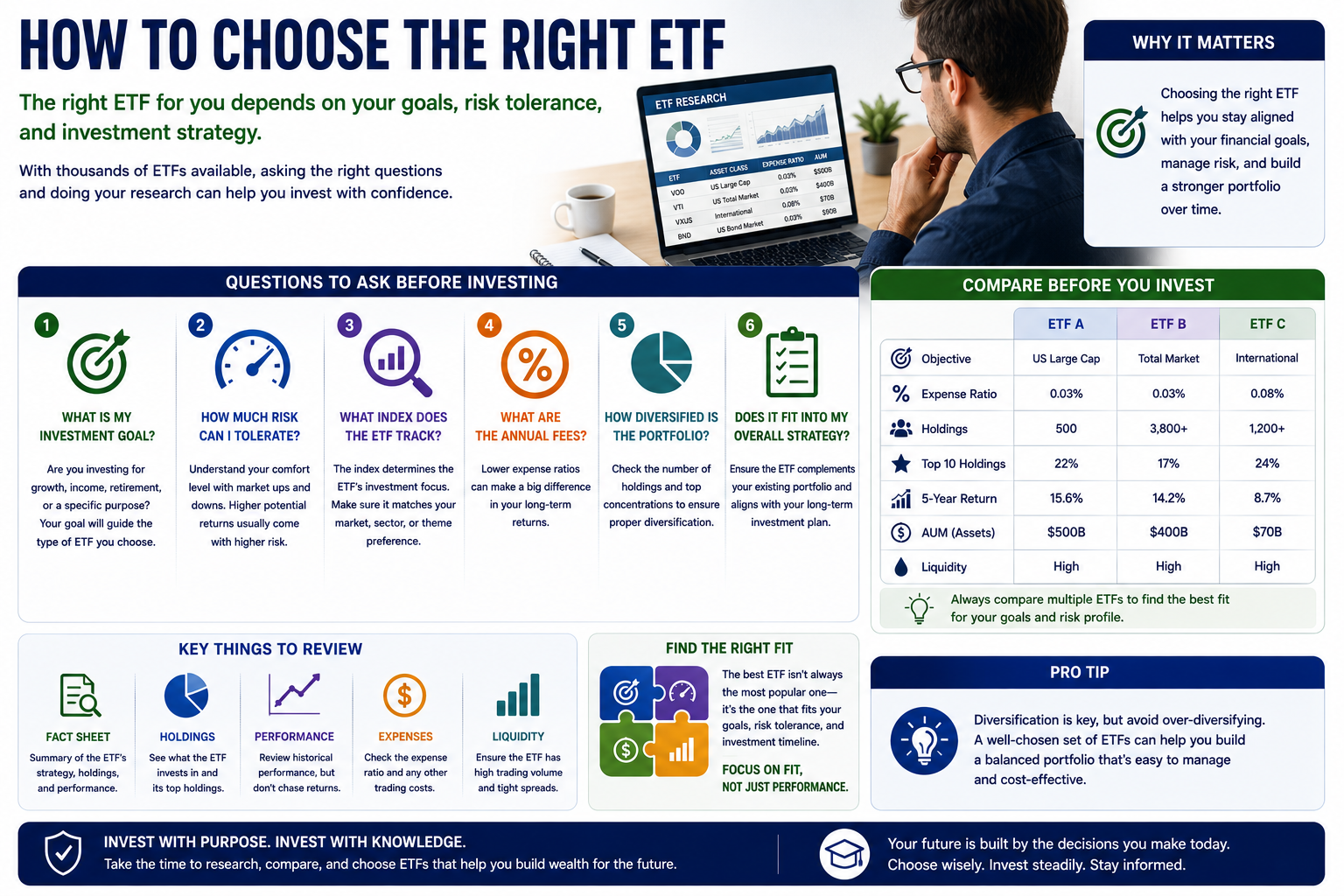
With thousands of ETFs available worldwide, selecting the right one requires careful research. Investors should focus on their financial objectives rather than chasing recent performance.
Questions to Ask Before Investing
- What is my investment goal?
- How much risk can I tolerate?
- What index does the ETF track?
- What are the annual fees?
- How diversified is the portfolio?
- Does it fit into my overall investment strategy?
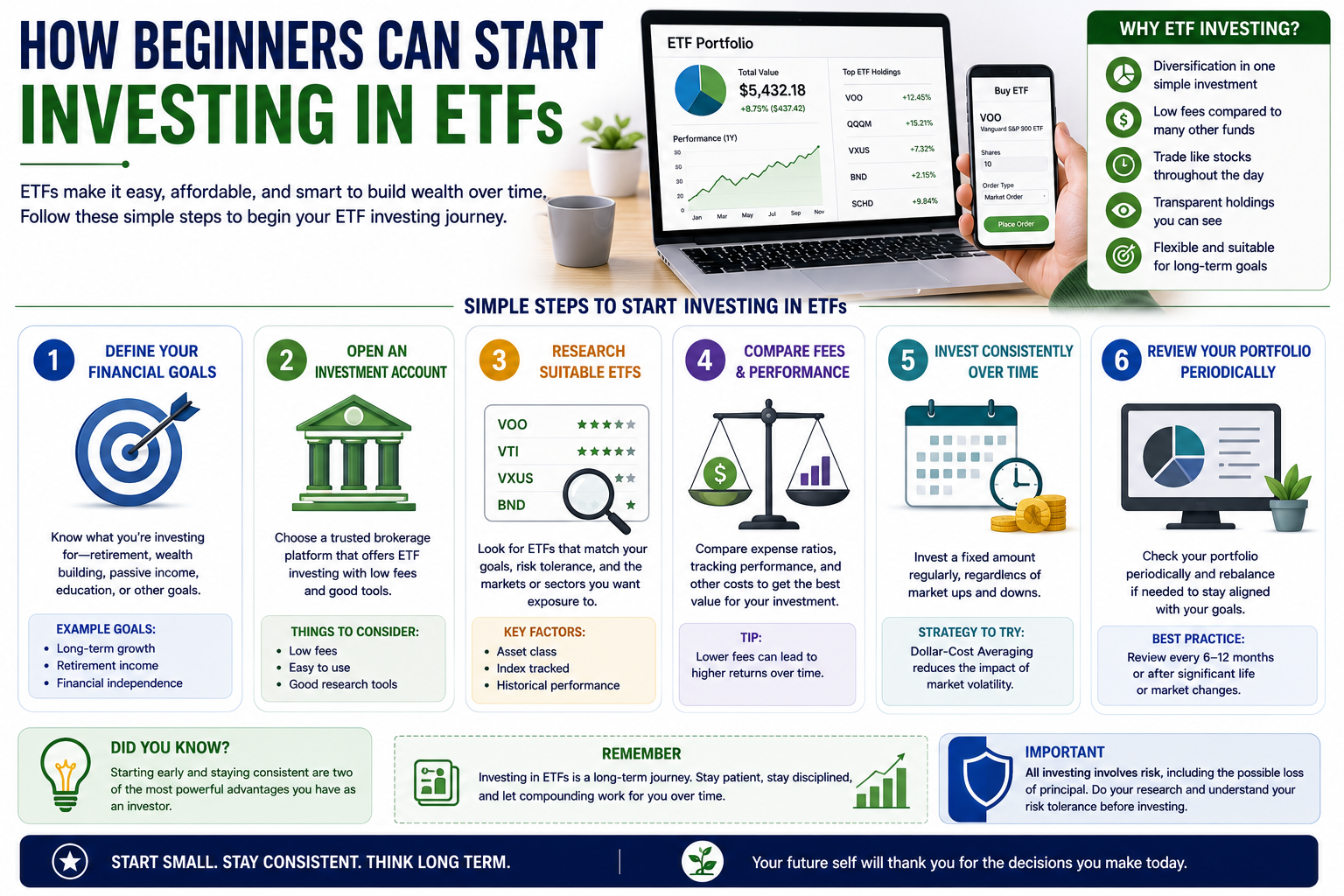
How Beginners Can Start Investing in ETFs
Getting started with ETFs is relatively straightforward. Many online brokerage platforms allow investors to purchase ETFs with small amounts of money.
Simple Steps
- Define your financial goals.
- Open an investment account.
- Research suitable ETFs.
- Compare fees and performance.
- Invest consistently over time.
- Review your portfolio periodically.
Many investors use dollar-cost averaging, which means investing a fixed amount at regular intervals regardless of market conditions. This approach can help reduce the impact of short-term market volatility.
Common ETF Investing Mistakes
Even though ETFs are beginner-friendly, investors can still make costly mistakes. Understanding these pitfalls can improve long-term investment success.
Mistakes to Avoid
- Investing without clear goals
- Ignoring ETF fees
- Chasing recent performance
- Failing to diversify
- Trying to time the market
- Selling during market downturns because of fear

Final Thoughts
Exchange-Traded Funds have transformed investing by making diversified portfolios more accessible, affordable, and transparent. Whether you are investing for retirement, building long-term wealth, generating passive income, or diversifying internationally, ETFs offer solutions for nearly every investment objective.
Before investing, take time to understand the ETF's investment strategy, costs, holdings, and associated risks. Building wealth is typically a long-term process that benefits from patience, discipline, and consistent investing.
Remember that all investments involve risk, including the possible loss of principal. Educational research and thoughtful planning can help investors make better financial decisions over time.
Have questions about ETFs or want to share your investing experience? Join the conversation and help other readers learn from real-world experiences.