
Bond Investing Explained: A Complete Beginner's Guide to Investing in Bonds
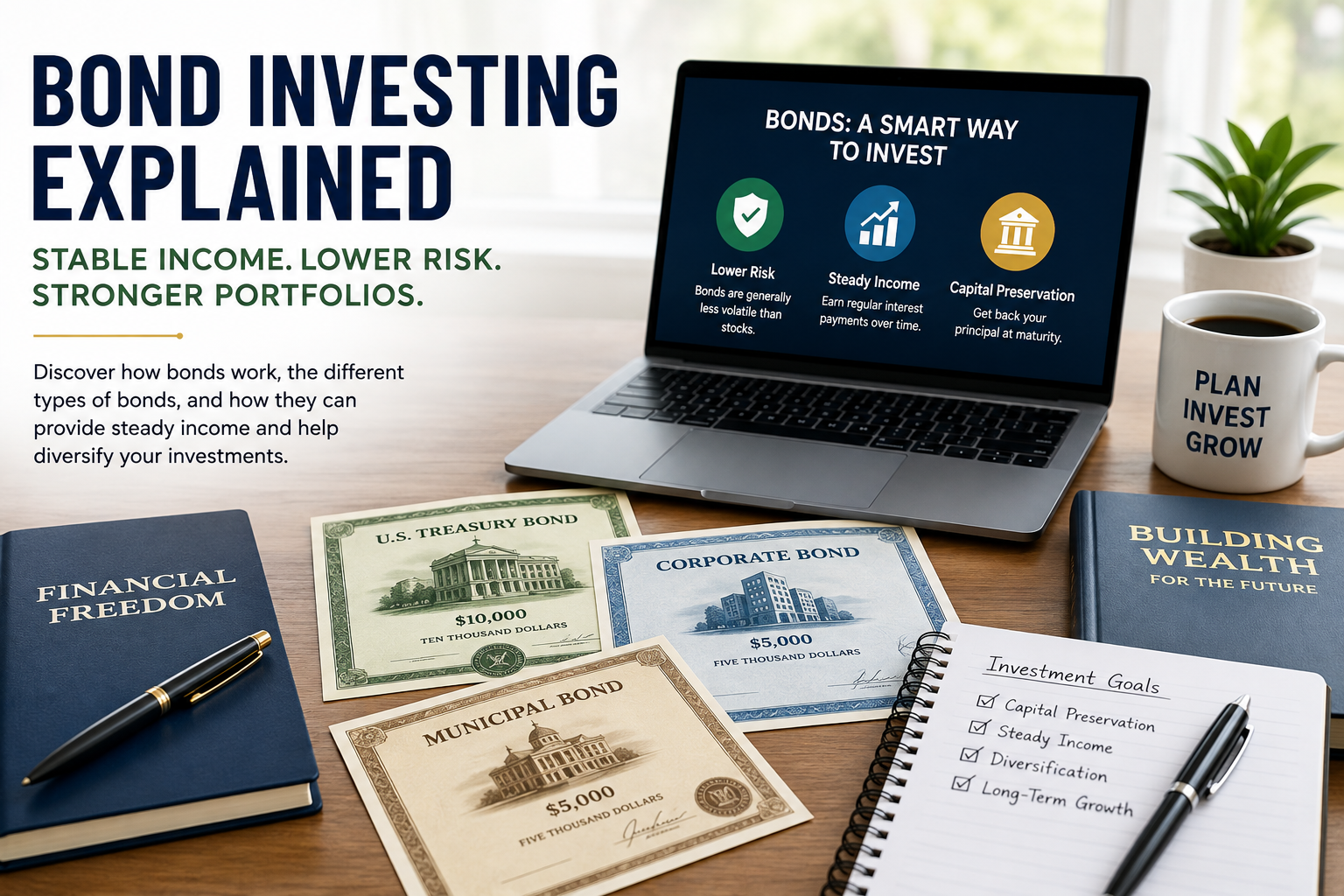
Learn how bonds work, why investors buy them, the different types of bonds available, how bond prices and yields are determined, and how bonds can provide steady income while helping diversify an investment portfolio.
Disclosure: Ads are displayed on this site. Our educational content is independent and is designed to help readers make informed investment decisions.
Key Takeaways
- What Are Bonds? — Understand the basics of fixed-income investing.
- Benefits of Bonds — Learn why bonds are popular among conservative investors.
- How Bonds Work — Discover how investors earn income from bonds.
- Types of Bonds — Explore government, corporate, municipal, and treasury bonds.
- Bond Prices & Yields — Learn how interest rates affect bond values.
- Bond Risks — Understand the potential risks before investing.
- How to Start Investing — Practical steps for beginners.
Bonds are among the oldest and most widely used investment products in the world. Governments, corporations, and other organizations issue bonds to raise money for projects, operations, or expansion, while investors purchase bonds in exchange for regular interest payments and the return of their principal when the bond reaches maturity.
Because bonds typically provide predictable income and are generally less volatile than stocks, they are often used to help preserve capital, generate steady cash flow, and diversify investment portfolios.
At Go-Superscribe, we provide practical, beginner-friendly investing guides that simplify financial concepts. This guide explains how bonds work, the different types available, their benefits and risks, and how they can fit into a long-term investment strategy.
What Are Bonds?
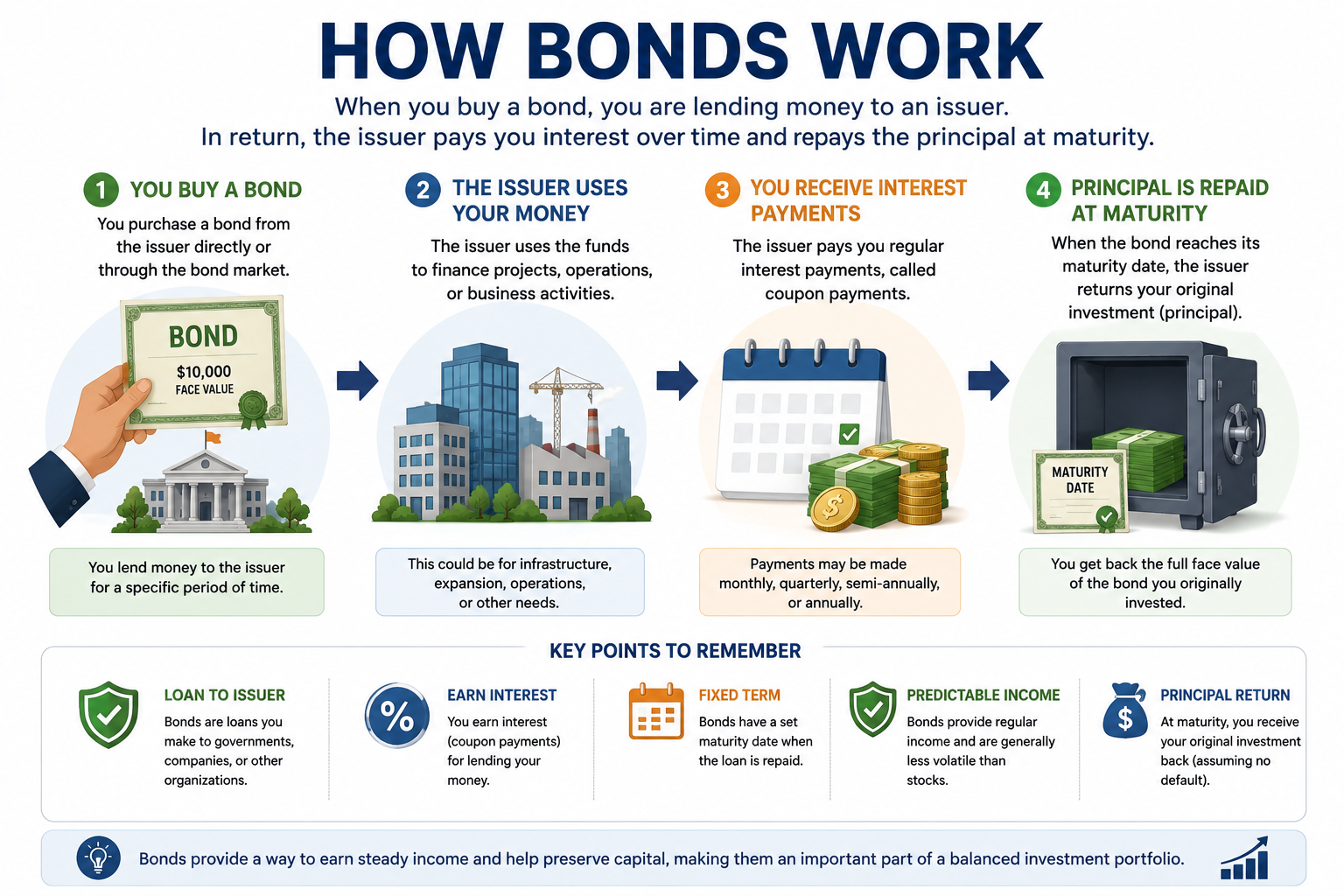
A bond is a fixed-income investment in which an investor lends money to a government, corporation, or other organization for a specified period. In return, the issuer agrees to pay periodic interest, known as coupon payments, and repay the original investment (called the principal or face value) when the bond matures.
Unlike stocks, which represent ownership in a company, bonds represent a loan made by the investor. Because of this, bondholders are creditors rather than owners of the issuing organization.
Bonds are widely used by investors seeking stable income, lower portfolio volatility, and greater diversification alongside other investments such as stocks and mutual funds.
Benefits of Investing in Bonds
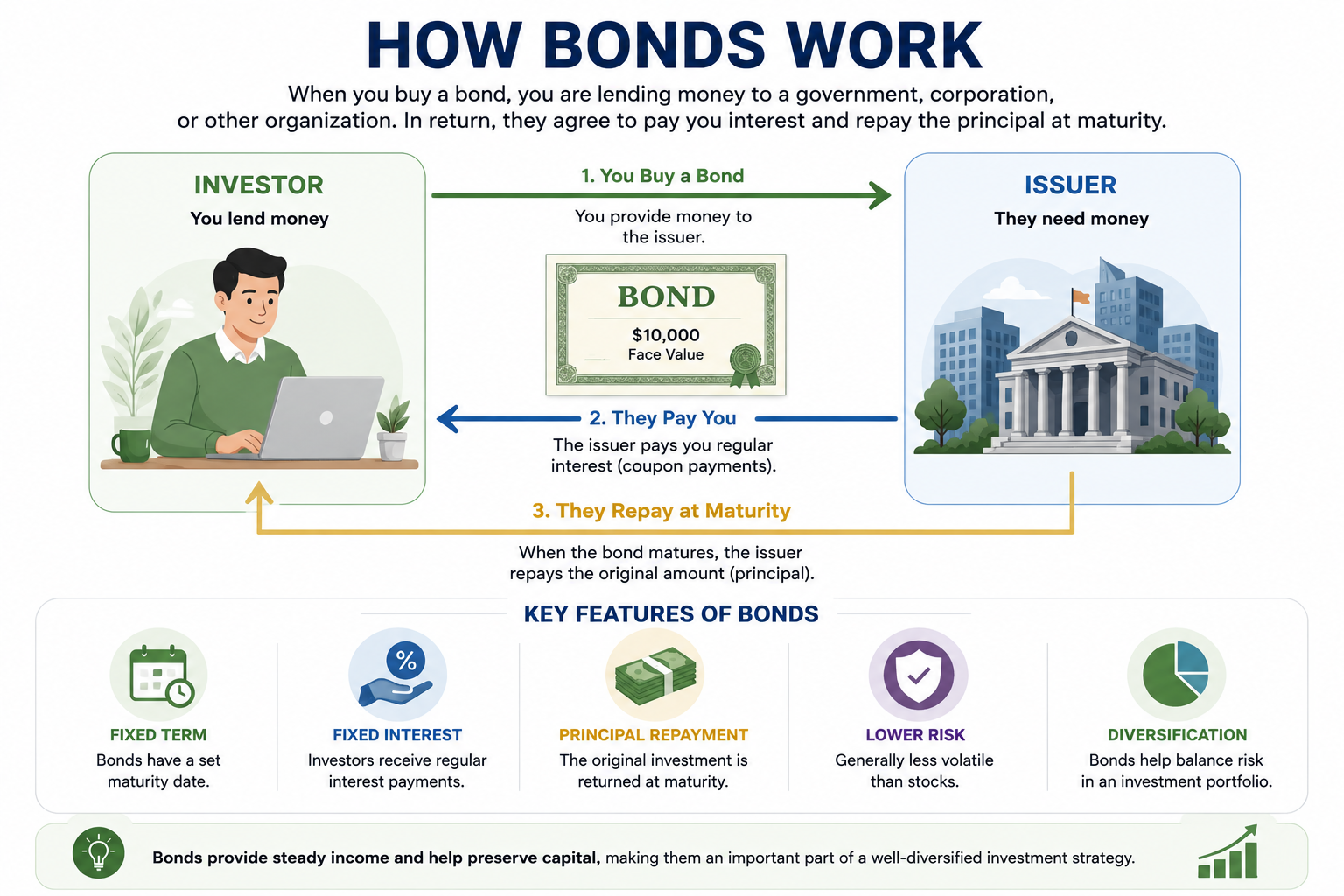
Bonds are widely regarded as one of the most reliable investment options for generating steady income and preserving capital. While they generally do not offer the same growth potential as stocks, they can provide greater stability, making them an important component of a diversified investment portfolio.
Many investors include bonds in their portfolios to help reduce overall risk, generate predictable cash flow, and achieve long-term financial goals such as retirement planning or funding future expenses.
Key Benefits of Bonds
- Regular interest payments that provide consistent income
- Generally lower risk than investing in individual stocks
- Help diversify investment portfolios
- Can preserve capital when held until maturity
- Wide range of investment choices for different risk levels
- Suitable for retirement and income-focused investing
How Bonds Work
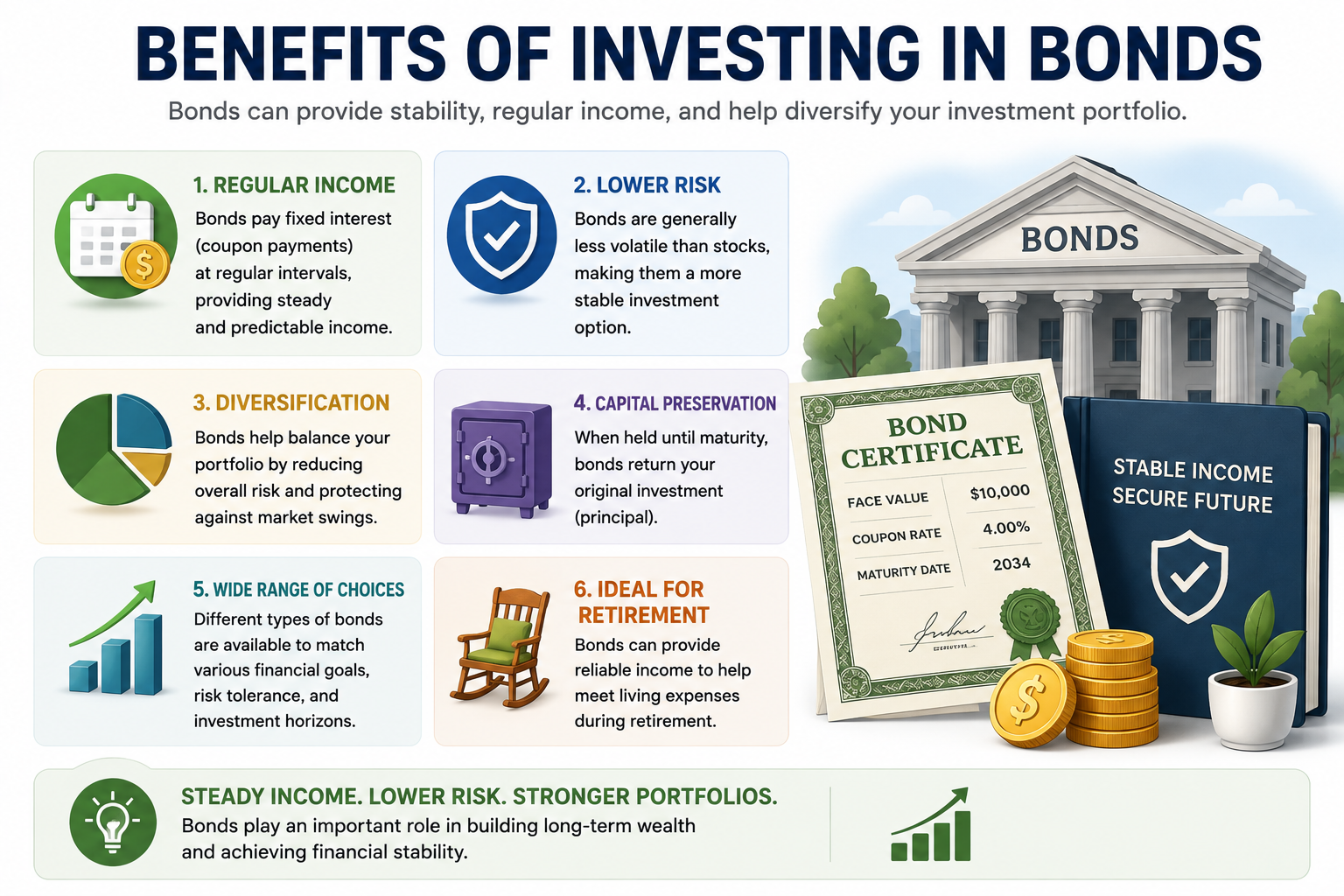
When you purchase a bond, you are lending money to the bond issuer for a specific period of time. In exchange, the issuer agrees to pay you interest at regular intervals and repay the original investment when the bond reaches its maturity date.
The interest paid by a bond is called the coupon. Coupon payments may be made monthly, quarterly, semi-annually, or annually, depending on the terms of the bond.
When the bond matures, the issuer returns the face value (also called the principal) to the investor, assuming the issuer does not default on its obligations.
How the Bond Process Works
- You purchase a bond from the issuer or through the secondary market.
- The issuer uses your money to finance projects or operations.
- You receive regular interest payments throughout the life of the bond.
- When the bond matures, your original investment is repaid.
Who Issues Bonds?
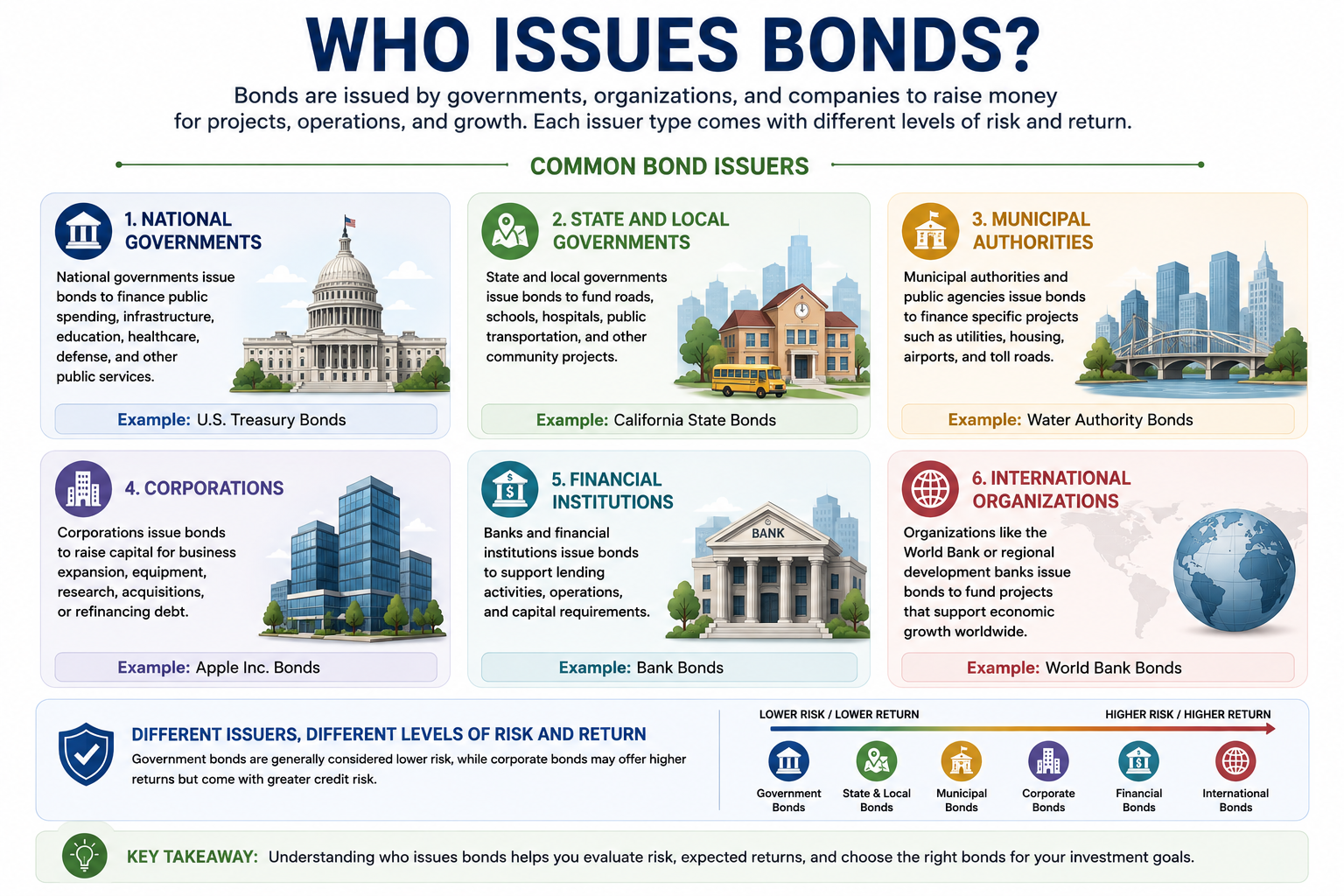
Many different organizations issue bonds to raise money. Governments use bonds to finance infrastructure, education, healthcare, and public services. Companies issue bonds to fund business expansion, purchase equipment, refinance debt, or invest in new projects.
Each type of issuer carries a different level of risk and potential return. Government bonds are generally considered lower risk, while corporate bonds may offer higher interest rates because they often involve greater credit risk.
Common Bond Issuers
- National governments
- State and local governments
- Municipal authorities
- Large corporations
- Financial institutions
- International organizations
Important Bond Terms Every Beginner Should Know
Learning a few key bond terms makes it much easier to understand how bonds are priced and how they generate returns. These concepts appear frequently when comparing different bond investments.
Essential Terms
- Face Value (Par Value): The amount the issuer repays when the bond matures.
- Coupon Rate: The annual interest rate paid on the bond.
- Maturity Date: The date when the bond expires and the principal is repaid.
- Yield: The actual return an investor earns based on the bond's current price.
- Issuer: The government, company, or organization borrowing the money.
Understanding these terms will help you compare bonds more effectively and make informed investment decisions.
Types of Bonds
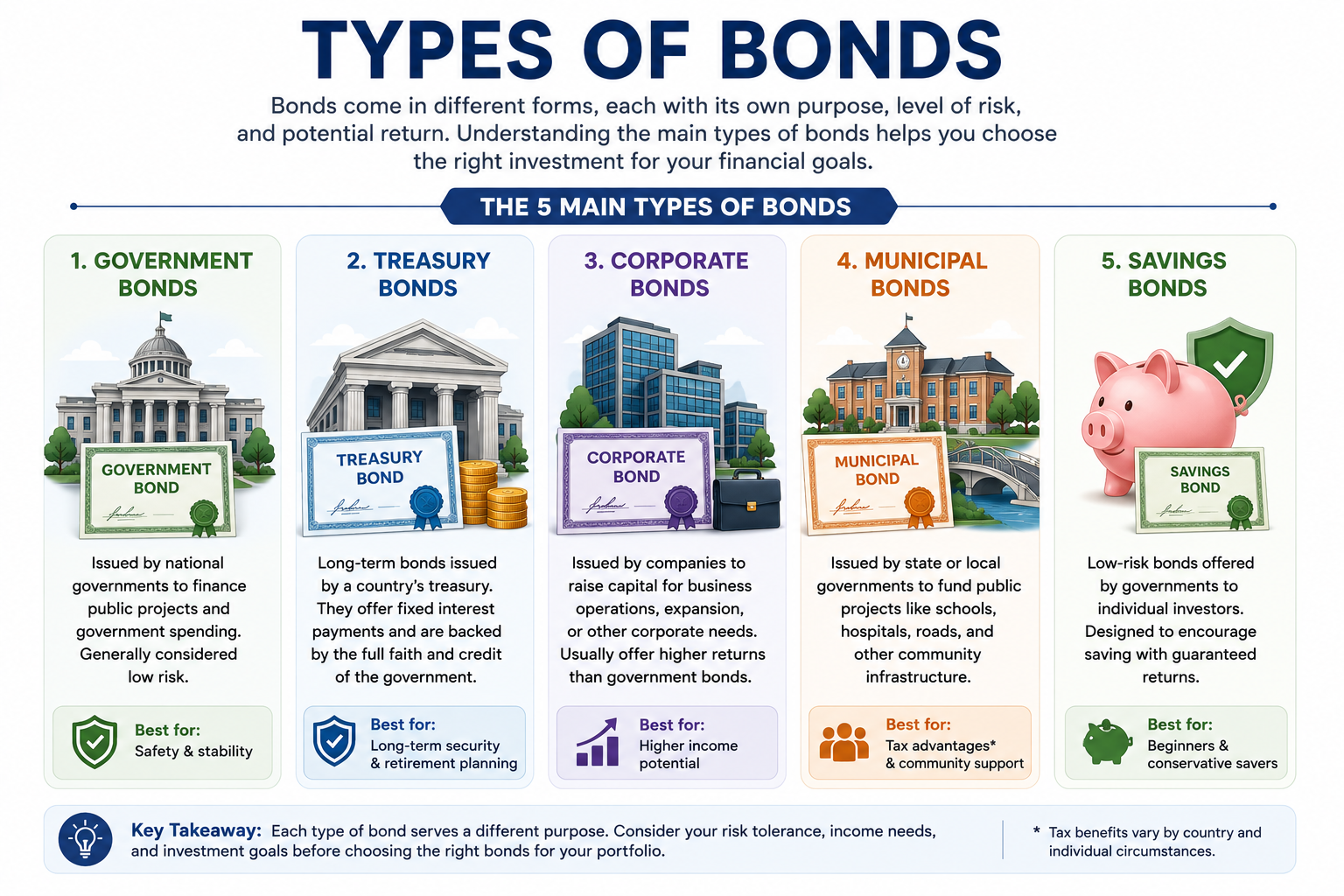
Bonds come in different forms, each with its own purpose, level of risk, and potential return. Some are issued by governments to finance public spending, while others are issued by companies to fund business operations or expansion.
Understanding the major types of bonds helps investors choose investments that align with their financial goals, income needs, and tolerance for risk.
Main Types of Bonds
- Government Bonds
- Treasury Bonds
- Corporate Bonds
- Municipal Bonds
- Savings Bonds
Government Bonds
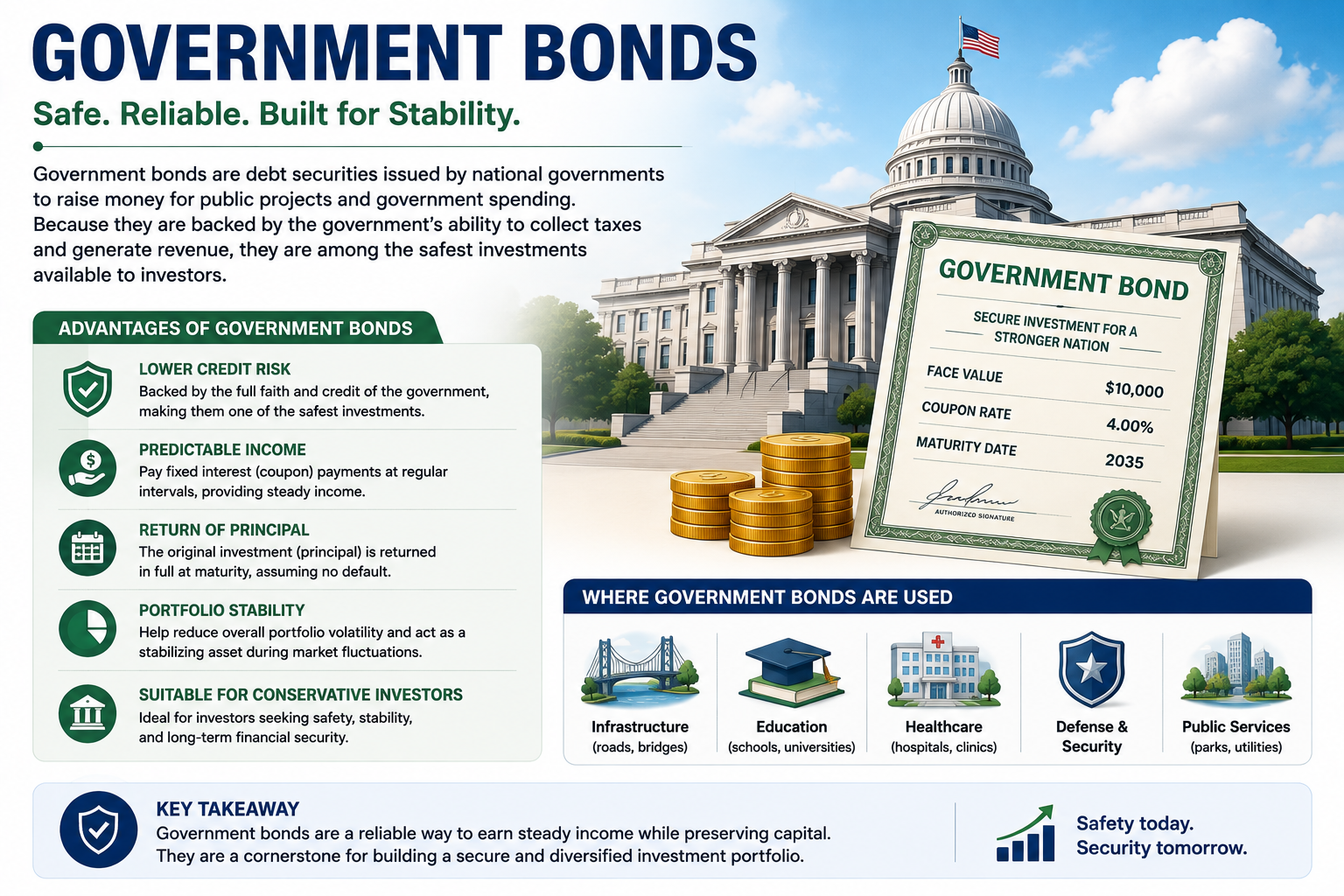
Government bonds are issued by national governments to raise money for public projects and government spending. Because they are backed by the government's ability to collect taxes and generate revenue, they are generally considered among the safest investments available.
Government bonds are popular with conservative investors seeking stable income and lower risk. They are often used as a core component of retirement and long-term investment portfolios.
Advantages of Government Bonds
- Generally lower credit risk
- Predictable interest payments
- Capital returned at maturity
- Suitable for conservative investors
- Can help diversify an investment portfolio
Treasury Bonds
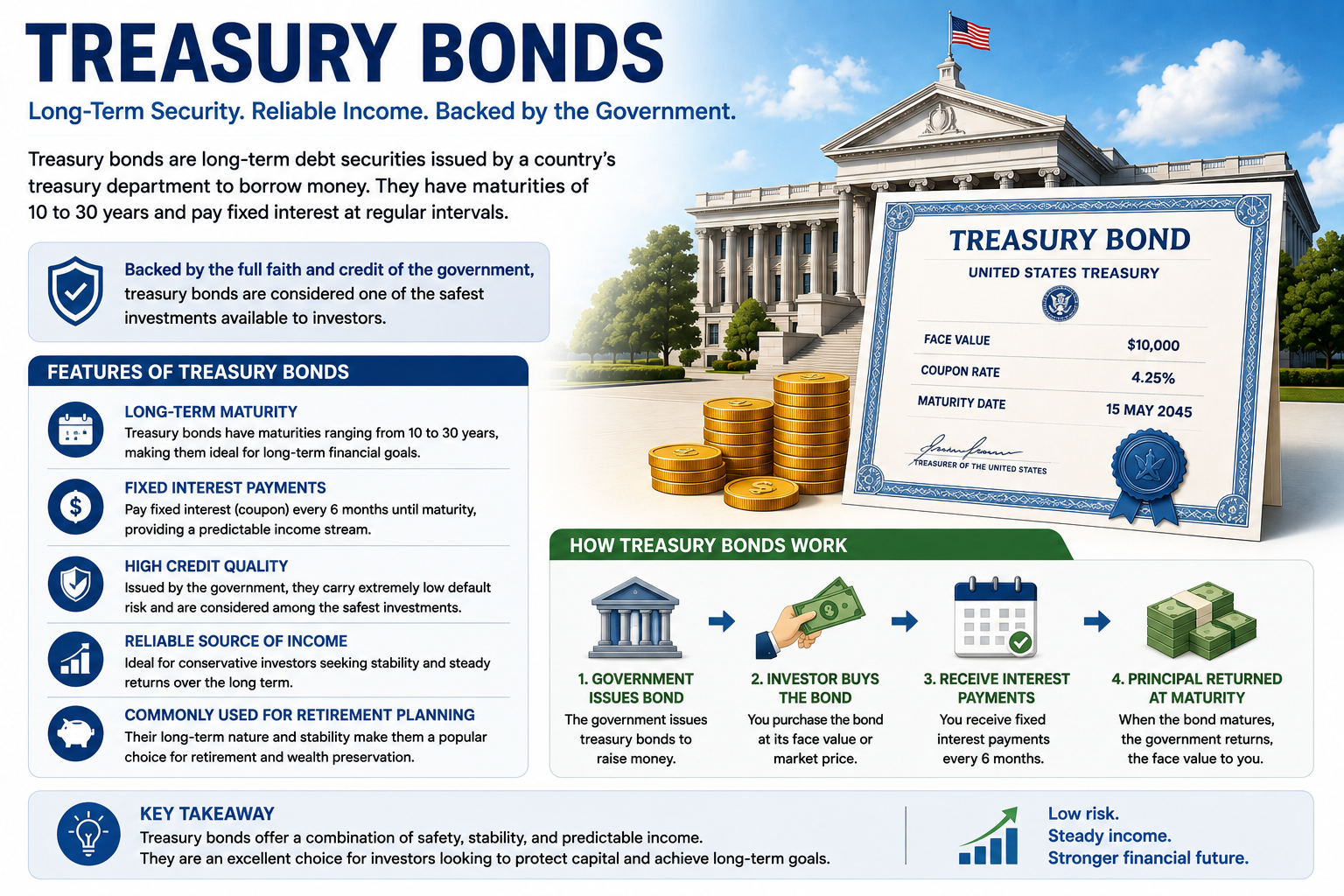
Treasury bonds are long-term government securities issued by a country's treasury department or finance ministry. They typically have maturities ranging from 10 to 30 years and pay fixed interest at regular intervals.
Because treasury bonds are backed by the full faith and credit of the issuing government, they are widely regarded as one of the lowest-risk investments available, although their market value may fluctuate as interest rates change.
Features of Treasury Bonds
- Long-term maturity
- Fixed interest payments
- High credit quality
- Reliable source of income
- Commonly used for retirement planning
Corporate Bonds
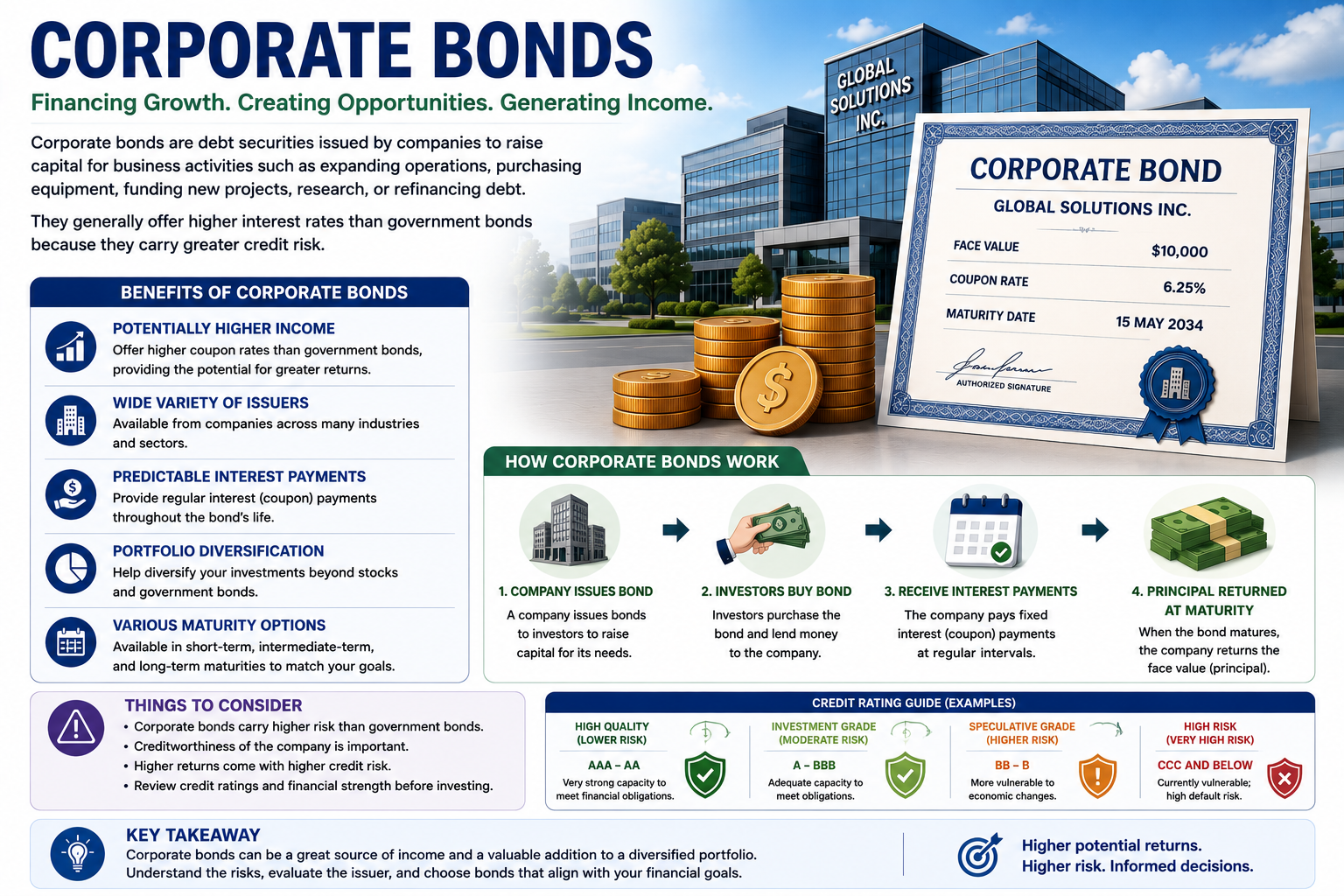
Corporate bonds are issued by companies to raise capital for business activities such as expanding operations, purchasing equipment, funding research, or refinancing existing debt.
Compared with government bonds, corporate bonds generally offer higher interest rates because they carry greater credit risk. Investors should consider the financial strength and credit rating of the issuing company before investing.
Benefits of Corporate Bonds
- Potentially higher income than government bonds
- Wide variety of industries and issuers
- Predictable interest payments
- Portfolio diversification
- Available in different maturity periods
Municipal Bonds
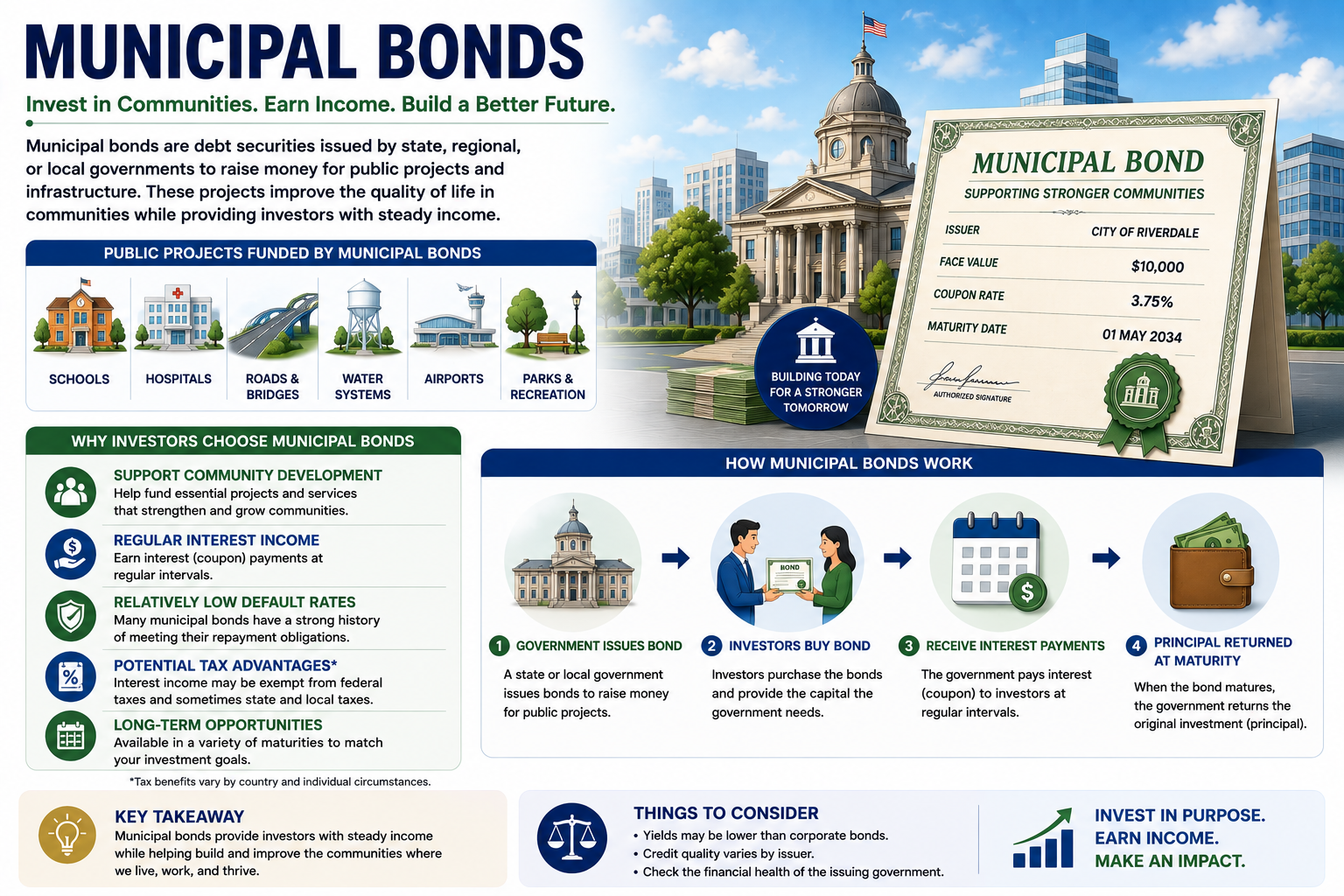
Municipal bonds are issued by state, regional, or local governments to finance public projects such as schools, hospitals, roads, bridges, airports, water systems, and other community infrastructure.
In some countries, municipal bonds may provide tax advantages, making them attractive to certain investors seeking both income and potential tax benefits.
Why Investors Choose Municipal Bonds
- Support community development
- Regular interest income
- Generally lower default rates than many corporate issuers
- Potential tax benefits in some jurisdictions
- Long-term investment opportunities
Bond Prices and Interest Rates
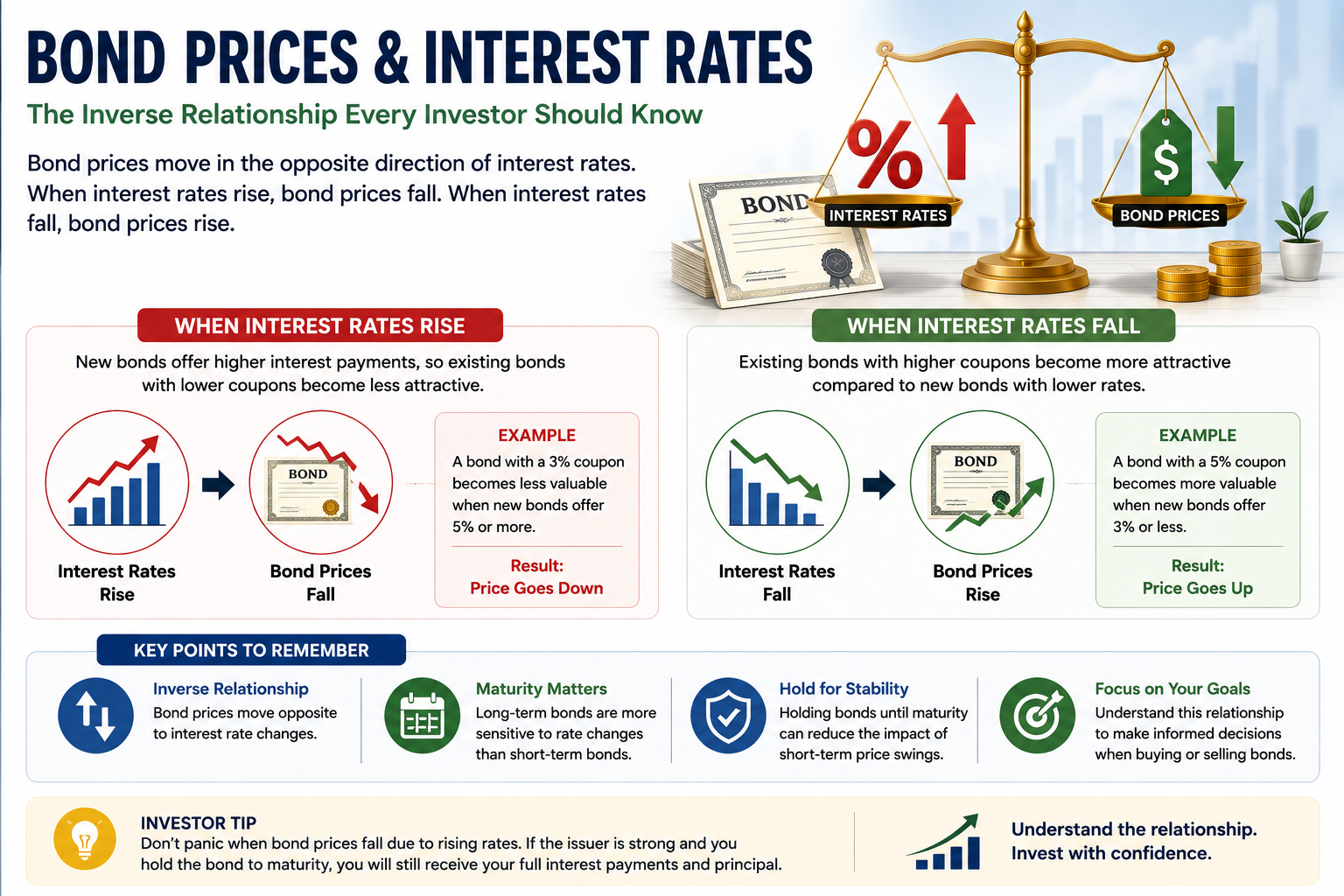
One of the most important concepts in bond investing is the relationship between bond prices and interest rates. Unlike stocks, bond prices are heavily influenced by changes in prevailing interest rates throughout the economy.
When interest rates rise, newly issued bonds generally offer higher coupon rates, making existing bonds with lower interest payments less attractive. As a result, the market price of existing bonds tends to fall. Conversely, when interest rates decline, older bonds with higher coupon payments often become more valuable, causing their prices to rise.
Understanding this inverse relationship helps investors make informed decisions when buying, holding, or selling bonds.
Key Points
- Bond prices usually fall when interest rates rise.
- Bond prices usually rise when interest rates fall.
- Long-term bonds are generally more sensitive to interest rate changes than short-term bonds.
- Holding a bond until maturity can reduce the impact of temporary price fluctuations.
Understanding Bond Yields
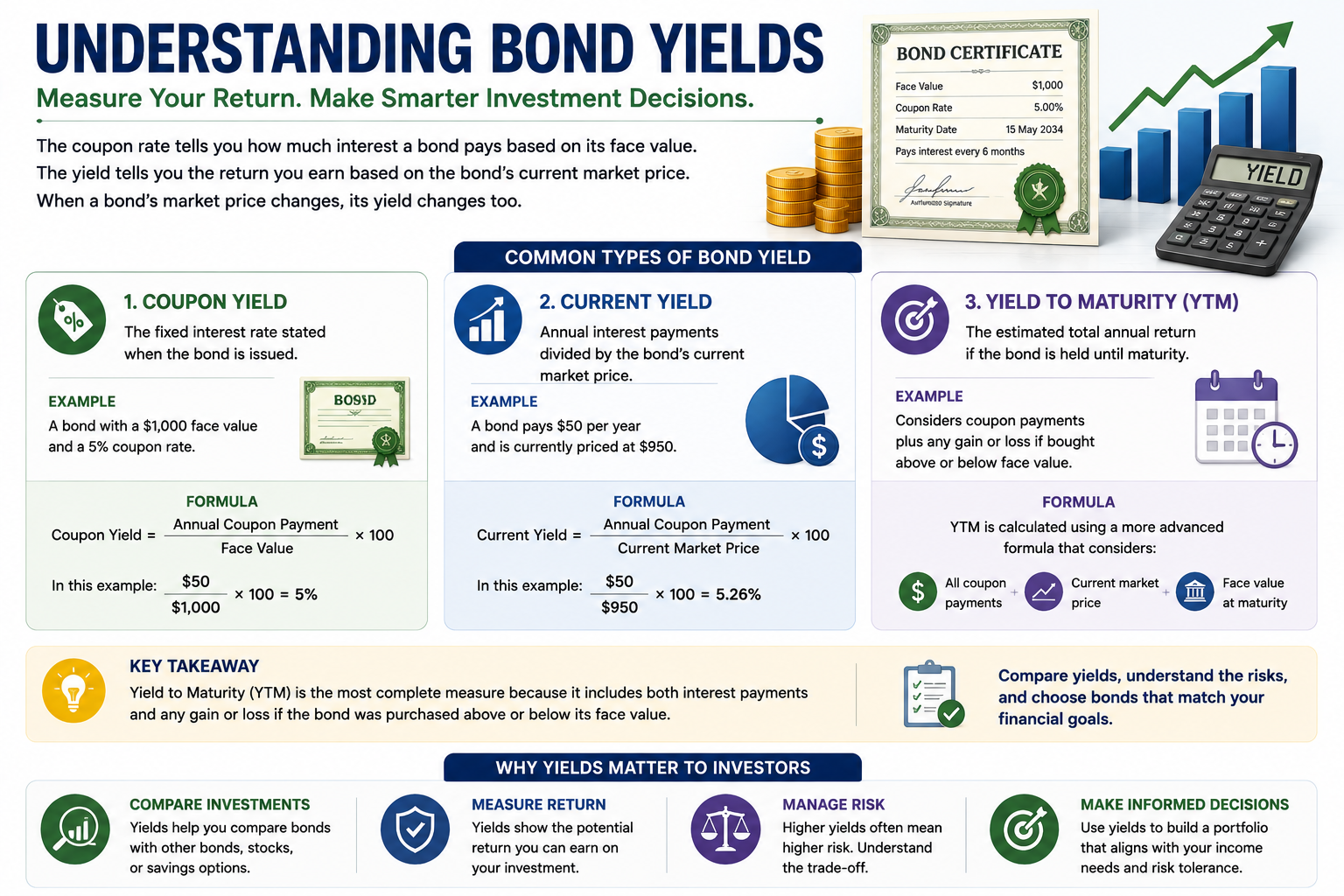
While the coupon rate tells you how much interest a bond pays based on its face value, the yield represents the return an investor earns based on the bond's current market price.
If a bond's market price changes, its yield changes as well. Investors often compare bond yields when deciding between different investment opportunities.
Common Types of Bond Yield
- Coupon Yield: The fixed interest rate stated when the bond is issued.
- Current Yield: Annual interest payments divided by the bond's current market price.
- Yield to Maturity (YTM): The estimated total annual return if the bond is held until maturity.
Yield to maturity is one of the most commonly used measures because it considers both interest payments and any gain or loss that may occur if the bond was purchased above or below its face value.
Bond Credit Ratings
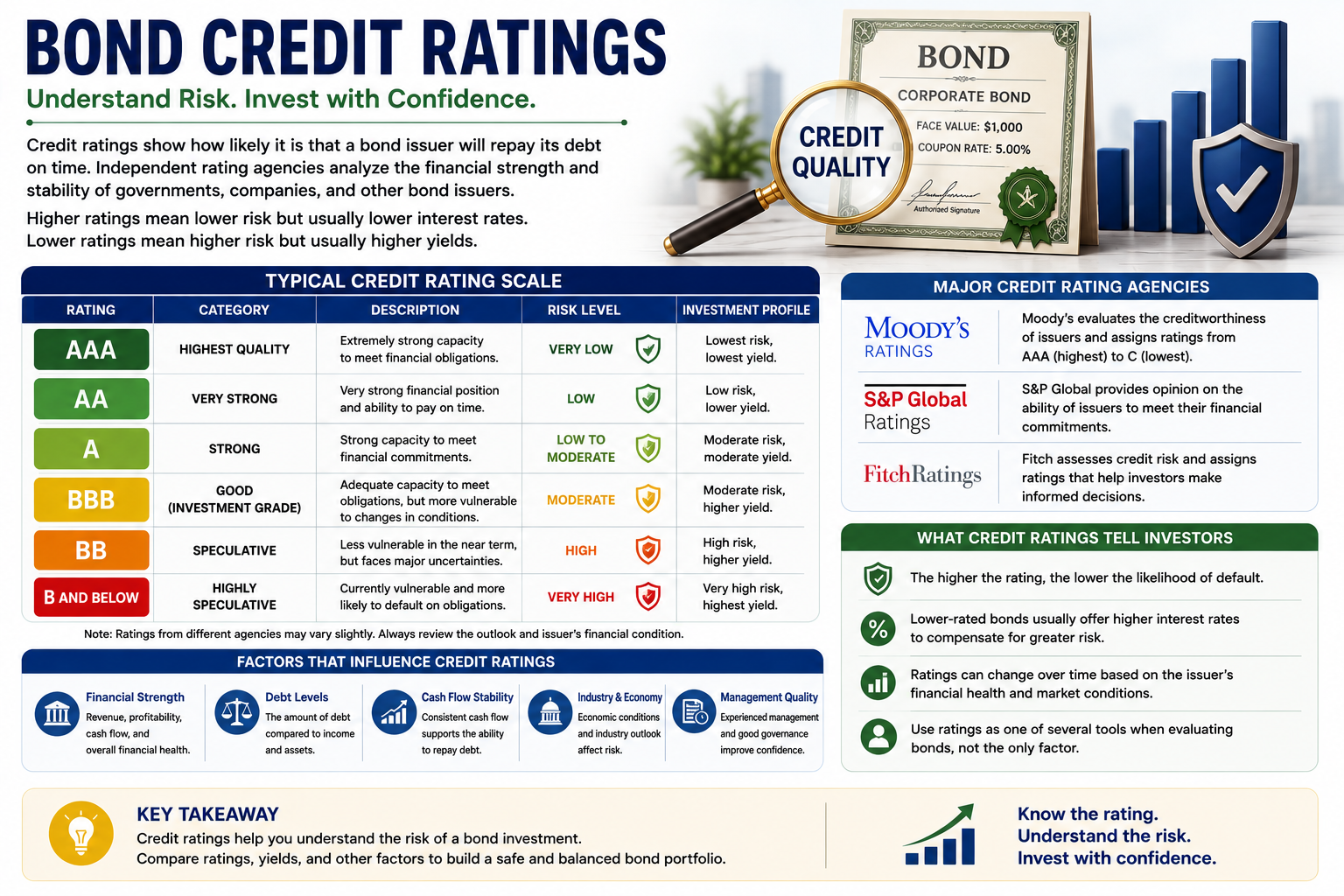
Credit ratings help investors evaluate the likelihood that a bond issuer will repay its debt on time. Independent credit rating agencies assess the financial strength of governments, corporations, and other bond issuers.
Higher-rated bonds generally have lower risk but may offer lower interest rates. Lower-rated bonds often provide higher yields to compensate investors for taking additional risk.
Typical Credit Rating Categories
- AAA - Highest credit quality
- AA - Very strong financial position
- A - Strong credit quality
- BBB - Investment-grade bond
- BB and below - Higher investment risk
Credit ratings are useful tools, but they should be considered alongside other factors such as the issuer's financial condition, market environment, and investment objectives.
Understanding the Risks of Bond Investing
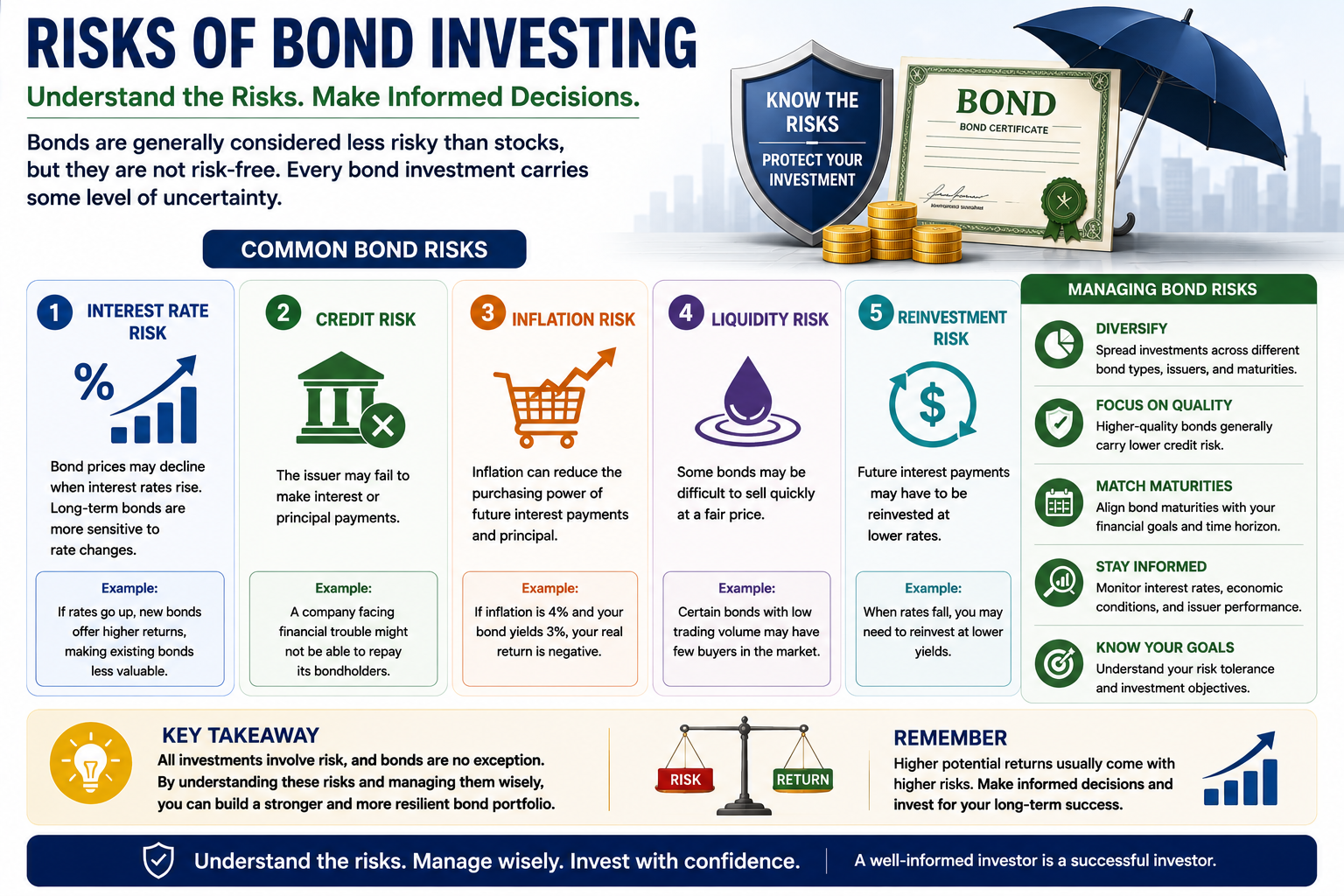
Although bonds are generally considered less volatile than stocks, they are not risk-free. Every bond investment carries some level of uncertainty, and understanding these risks can help investors make better financial decisions.
Common Bond Risks
- Interest Rate Risk: Bond prices may decline when interest rates rise.
- Credit Risk: The issuer may fail to make interest or principal payments.
- Inflation Risk: Inflation can reduce the purchasing power of future interest payments.
- Liquidity Risk: Some bonds may be difficult to sell quickly at a fair price.
- Reinvestment Risk: Future interest payments may have to be reinvested at lower rates.
Diversifying across different bond types, issuers, and maturities can help reduce overall investment risk.
How to Start Investing in Bonds
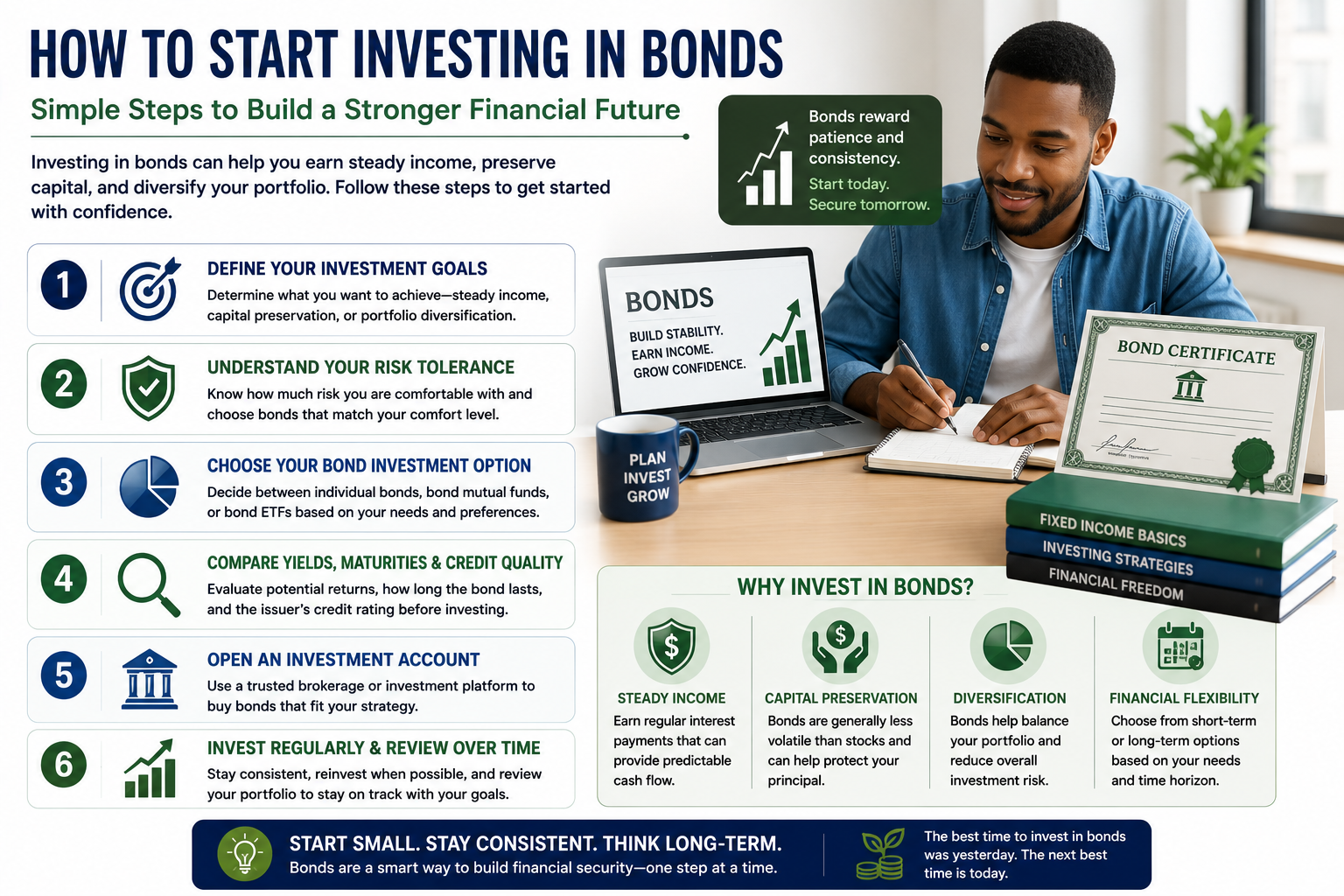
Investing in bonds has become more accessible than ever. You can purchase individual bonds directly from governments or companies, invest through brokerage accounts, or gain diversified exposure by investing in bond mutual funds or bond exchange-traded funds (ETFs).
Before investing, determine your financial goals, investment time horizon, income needs, and risk tolerance. These factors will help you select the most appropriate bond investments for your portfolio.
Steps to Begin
- Define your investment goals.
- Understand your risk tolerance.
- Choose between individual bonds, bond funds, or bond ETFs.
- Compare yields, maturities, and credit quality.
- Open an investment account.
- Invest regularly and review your portfolio over time.
Individual Bonds vs. Bond Funds
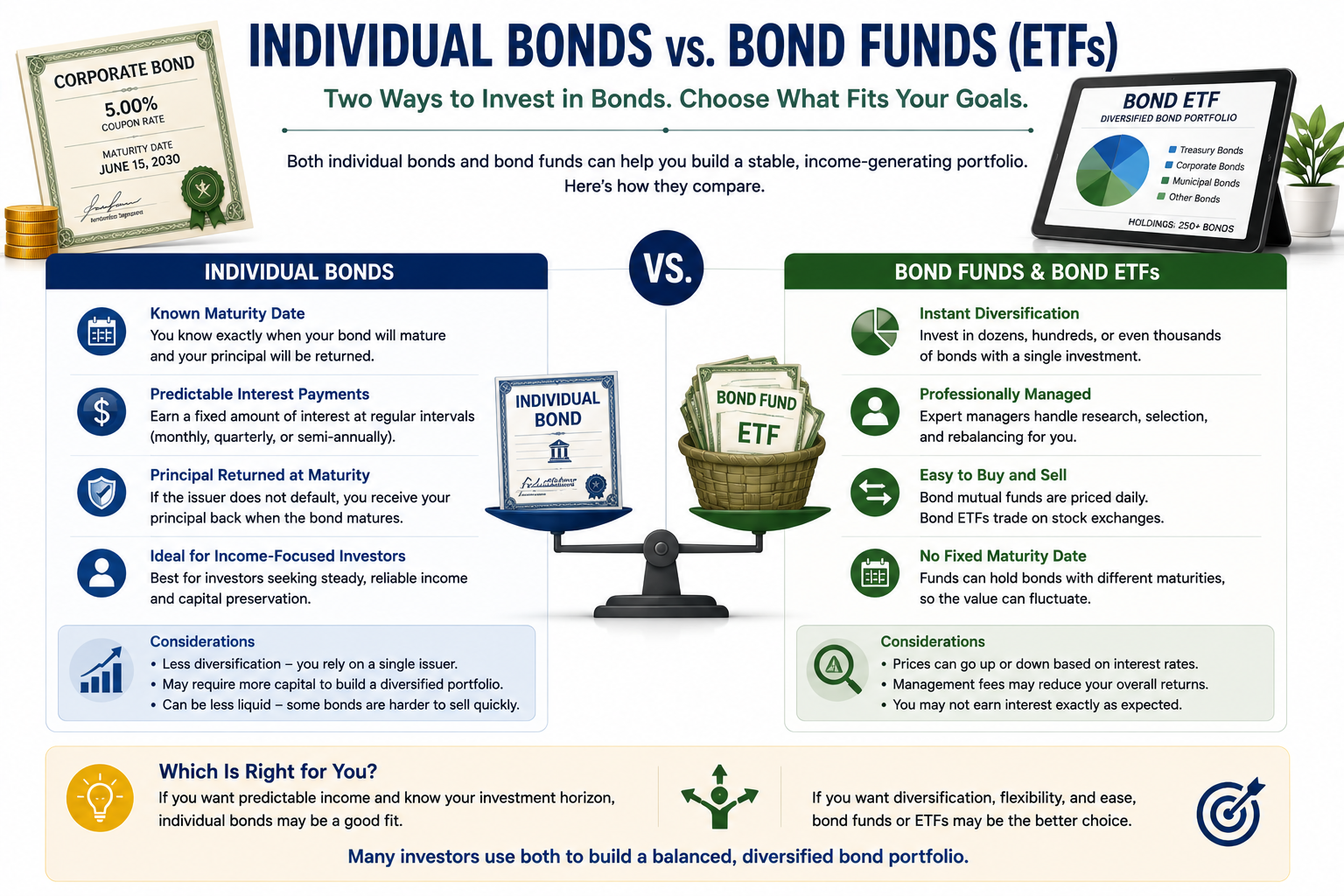
Investors can gain exposure to bonds either by purchasing individual bonds or by investing in bond mutual funds and bond ETFs. Each approach has advantages depending on your investment objectives.
Individual Bonds
- Known maturity date
- Predictable interest payments
- Principal is generally returned at maturity if the issuer does not default
- Suitable for investors seeking stable income
Bond Funds and Bond ETFs
- Instant diversification across many bonds
- Professionally managed portfolios
- Easier to buy and sell than individual bonds
- May not have a fixed maturity date
Many beginner investors choose bond funds or ETFs because they provide broad diversification with a single investment.
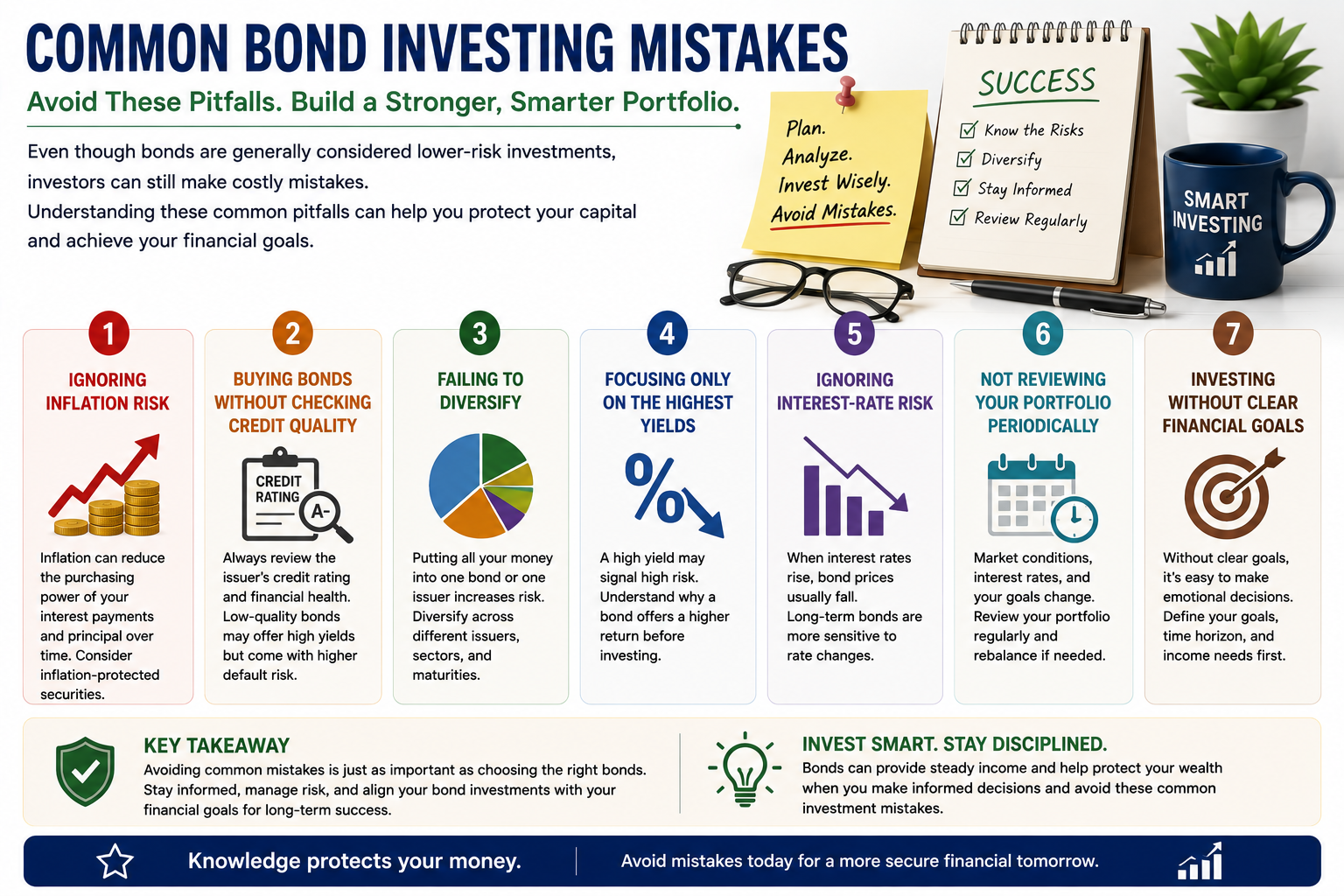
Common Bond Investing Mistakes
Although bonds are generally considered lower-risk investments, investors can still make costly mistakes. Understanding these common pitfalls can help you build a stronger long-term investment strategy.
Avoid These Mistakes
- Ignoring inflation risk.
- Buying bonds without understanding credit quality.
- Failing to diversify across issuers and maturities.
- Focusing only on the highest yields.
- Ignoring interest-rate risk.
- Not reviewing your portfolio periodically.
- Investing without clear financial goals.
Final Thoughts
Bonds play an important role in many investment portfolios by providing regular income, helping preserve capital, and reducing overall portfolio volatility. While they generally offer lower growth potential than stocks, they can provide stability during periods of market uncertainty.
Understanding bond types, yields, interest-rate movements, credit ratings, and investment risks allows you to make informed decisions that align with your financial objectives.
At Go-Superscribe, we are committed to helping beginners build financial confidence through practical, easy-to-understand investing guides. Continue exploring our educational resources to expand your knowledge of stocks, ETFs, mutual funds, retirement planning, and long-term wealth building.
Are you considering investing in bonds or already earning income from them? Share your questions, experiences, or investing tips in the comments below. Your insights can help other readers better understand fixed-income investing and build more balanced investment portfolios.